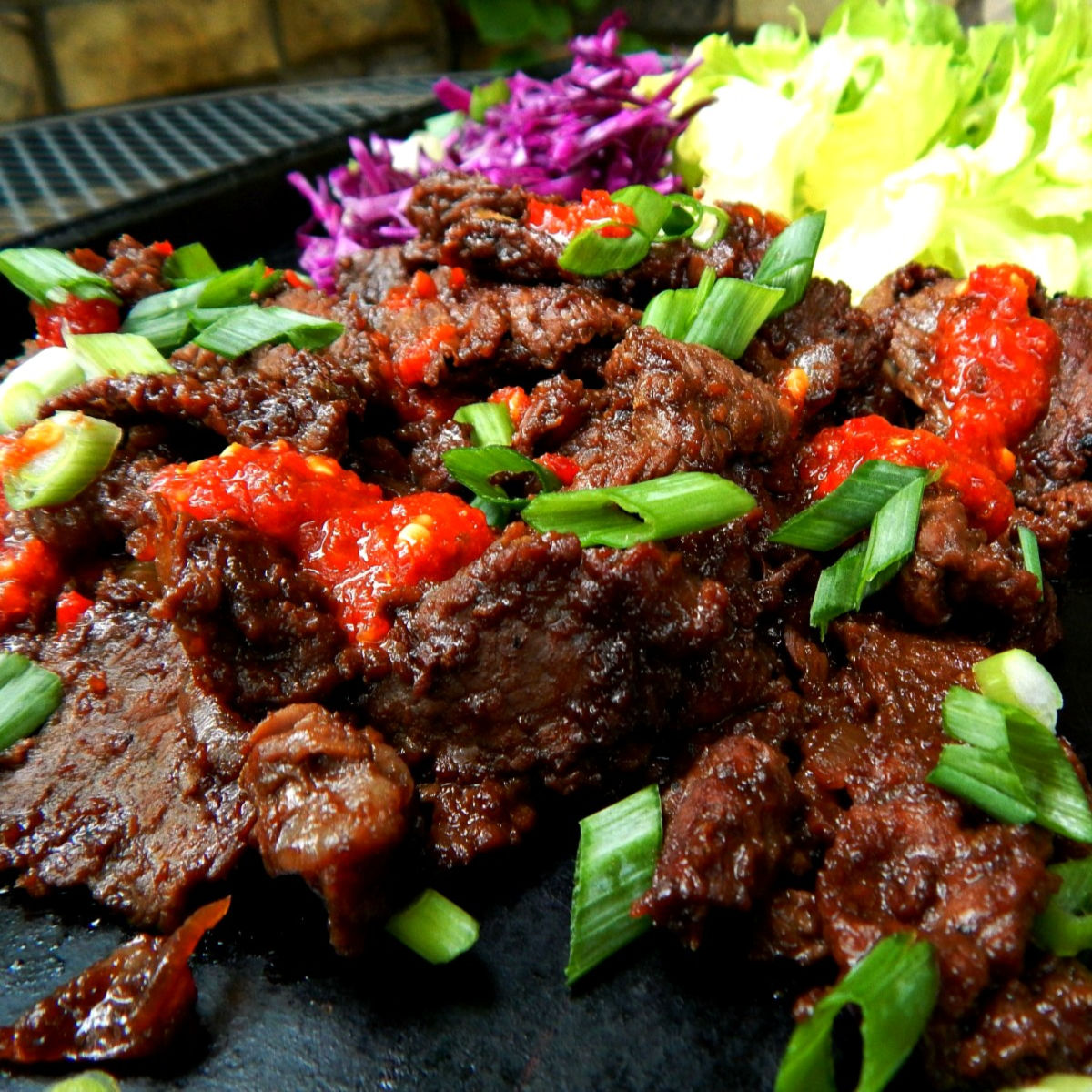

Is it just me, or is Korean food trending now? Maybe it’s me because when I crave a little something, I see it everywhere! It could be the Baader-Meinhof phenomenon, but I blame Chef David Chang and his wildly popular Korean American restaurant, Momofuku. He’s everywhere: TV, books, magazines! Regardless, I’m hoping to add to that trend with this fabulous Bulgogi Korean Beef.

Bulgogi Korean Beef

This isn’t a David Chang recipe, although there is one on my site: Momofuku’s Bo Ssam. Check it out – it’s insanely good. But let’s get back to the Bulgogi Korean Beef, below.
About Bulgogi Korean Beef:
Bulgogi is probably the most recognized of Korean dishes here in the States. Well, Bulgogi & Kimchi. I’m betting that once you try Bulgogi, you’ll want it again and again. And again. Yep, it’s crave-worthy. I guess you’ll just have to try it and see!
When I say Bulgogi, I mean thin, melt-in-your-mouth slices of beef, marinated overnight until every bit is saturated with flavor. Then it’s grilled (or more often at my house, seared off in a skillet) until the marinade that clings to the beef deepens and darkens, and sears itself right into that magic caramelized zone. It’s rich, savory, and just the way we Americans (yes, me included) seem to crave it!
The Marinade:
That marinade? It’s transformative. It’s a little sticky, a little sweet, layered with garlicky, gingery depth, and just enough brightness from a splash of rice wine vinegar to keep things lively.
The secret ingredient is the Asian pear. It doesn’t just add subtle fruity flavor; it works behind the scenes to tenderize the beef, making it all the more luscious. No Asian pear? No worries. A regular pear or a sweet apple will pinch-hit beautifully.
I like Bulgogi so much, I actually planted a dwarf variety of Asian pear last year, and that little baby is already putting out so much fruit, I had to thin some AND prop up some of the branches!

My baby Asian Pear. It’s already put out so many pears that I had to thin them and prop up some of the branches!
Serving Your Bulgogi:
Then you’re going to serve your Bulgogi Korean Beef with lots of little dishes (maybe some Kimchi) and Ssamjang (sauce) or maybe some Gochujang or Sriracha or any Chili Garlic Sauce, as we did. You might even want to add one of these spicy sauces to the marinade for a little kick, although that’s probably more of a U.S. thing to do.
To keep it simple, serve your Bulgogi Korean Beef over rice. If you want to be like me, which is kind of a weird thing to say, now that I think about it, and make your Bulgogi into wraps, toss out lettuce leaves, thinly sliced cabbage, or Asian Leaning Slaw, then sprinkle the whole works with a little thinly sliced green onion as I did. And Toasted Sesame Seeds, as I didn’t – I forgot. Just plain forgot. *sighs*


Making Bulgogi Korean Beef:
Sometimes, you’ll see Bulgogi that includes mushrooms and wafer-thin sliced carrots. They’re often marinated right along with and cooked with the beef. It’s actually a great way to stretch that beef just a little.
It seems that here in the U.S., you’re likely to find fewer veggies (and more sugar) in Bulgogi than in Korea; at least that was my observation when reading translated Google sites, not that I’m any authority…
Bulgogi is traditionally grilled, and these days grilling in shallow, thin metal perforated grill pans is an option. The advantage is the smoky flavor that permeates the beef, and the juices drain a little, preventing steaming.
If you wish to cook indoors with a skillet, you’ll have a different but just as delish outcome. You’ll get beautifully caramelized seared edges on that beef.

Bulgogi Korean Beef Lettuce Wrap
Saving Money on Groceries:
What you pay for groceries depends not only on WHERE you shop, but WHEN. Be strategic and stock up at rock-bottom prices.
- The best sales are before holidays; check out Win at the Grocers. Use these sales not just for your holiday, but to stock up at a low for the coming weeks to months.
- Take advantage of discount stores like Aldi or Lidl. The pricing at Buyer’s clubs is not always the lowest, but can trump in quality; be selective.
Asian Condiments and Ingredients:
- Sales are usually unadvertised and often happen before the Chinese New Year. If your store has them, check the American/Asian and International aisles.
- Asian markets will usually have best pricing. While there, check around. Pricing on chicken and other proteins is often outstanding.
- Some basic items, like Soy Sauce, are now carried at the discount groceries, and many condiments are carried in larger grocery stores.
Steak:
When choosing steak, get the most bang for your buck. Know that larger steaks, sliced across the grain and served as a component of the meal helps to strech it.
- Leading up to New Year’s, Valentine’s Day, and Summer Holidays, groceries will have several types of steak at various times at various price points.
- Every steak has a corresponding roast, which can be sliced into steaks. Look for better roasts before Christmas & New Year’s, and cheaper roasts in January and February.
- Family packs can be a deal, but check the price per pound and compare. Divide and freeze the extra whole or slice or cube for recipes first. Label!
- Refashion leftover steak into meals that just need a bit. It’s a great way to take a pricier item and average that cost between two meals.
- Learn how/when to sub a cheaper cut for a pricier one. Often, the way the steak is cooked makes all the difference.
- Sirloin is usually an affordable cut, frequently goes on sale, and works well as a sub for many pricier cuts.
- Rule of thumb: The better the steak, the less should be done, but give a lot of love to cheaper steaks. Use marinades and rubs, keep them on the rare side, and always slice across the grain.
- Buyers’ club sales may not be the cheapest, but you will almost always find better quality steaks and roasts than at the grocery.
For This Recipe:
- For this recipe, check an Asian market or your buyers’ club for beef that’s already thinly sliced and ready to use.
- You may find other options to use instead of sirloin, but know your per-pound prices to compare!

Bulgogi Korean Beef
Bulgogi (Korean Beef)

- Prep Time: 15 minutes
- Cook Time: 15 minutes
- Total Time: 30 minutes + marinade
- Yield: 4 to 6 servings 1x
- Category: main dish beef
- Cuisine: Asian
Ingredients
- 1 1/2 pounds sirloin
- 1 onion, cut in half; cut one of the halves into half moons, the other half in chunks
- 4 cloves garlic
- 1 tablespoon roughly chopped ginger
- 1/2 Asian pear, in chunks
- 1/3 cup soy
- 1 or 2 tablespoons gochuchang, optional
- 2 tablespoons rice wine vinegar
- 1 teaspoon toasted sesame oil
- 3 tablespoons brown sugar
- 2 green onions, thinly sliced
- 1/4 teaspoon black pepper
- 2 tablespoons of toasted sesame seeds
- 2 green onions, sliced for garnish
- Lettuce, rice, and accompaniments of your choice
Instructions
Wrap the steak in plastic wrap and freeze for 20 minutes or so to firm up. Thinly slice across the grain into about 1/8″ slices.
Place the beef and sliced onion in a gallon freezer bag or a large bowl and set aside.
In a food processor, combine the chunked onion, garlic, Asian pear, and grated ginger and process until it’s broken down. Add the soy sauce, gochuchang (if using), vinegar, sesame oil, and sugar and pulse until combined. Pour over steak and onions and mix to combine. Add the sliced green onion and pepper and mix again. Refrigerate for 30 minutes up to overnight.
When ready to cook, preheat a cast-iron pan or large skillet over high heat, work in batches, or use two skillets. Add the meat, onions, and marinade to the pan. Cook, stirring constantly until the meat is cooked through, two to three minutes.
Push the meat off to one side and tilt skillet so the juices flow over to the other. Nudge the skillet so the majority of the heat from the eye is over the side with most of the juices and the meat is just off the heat. Continue to cook until the juices begin to brown and caramelize. Push the cooked meat back into the now caramelized juices and continue to cook a minute or two until the meat is coated and seared with the juices, two to three more minutes.
Repeat with the rest of the ingredients.
Garnish with sliced green onion and sesame seeds and serve with desired accompaniments.
Note: if you wish to serve over rice, you might not want the beef/sauce caramelized as much as those juices are wonderful as they mingle with rice.

I’ll be sharing Bulgogi Korean Beef on Fiesta Friday #138 hosted by Johanna of French Gardener Dishes.
48 thoughts on “Bulgogi Korean Beef”