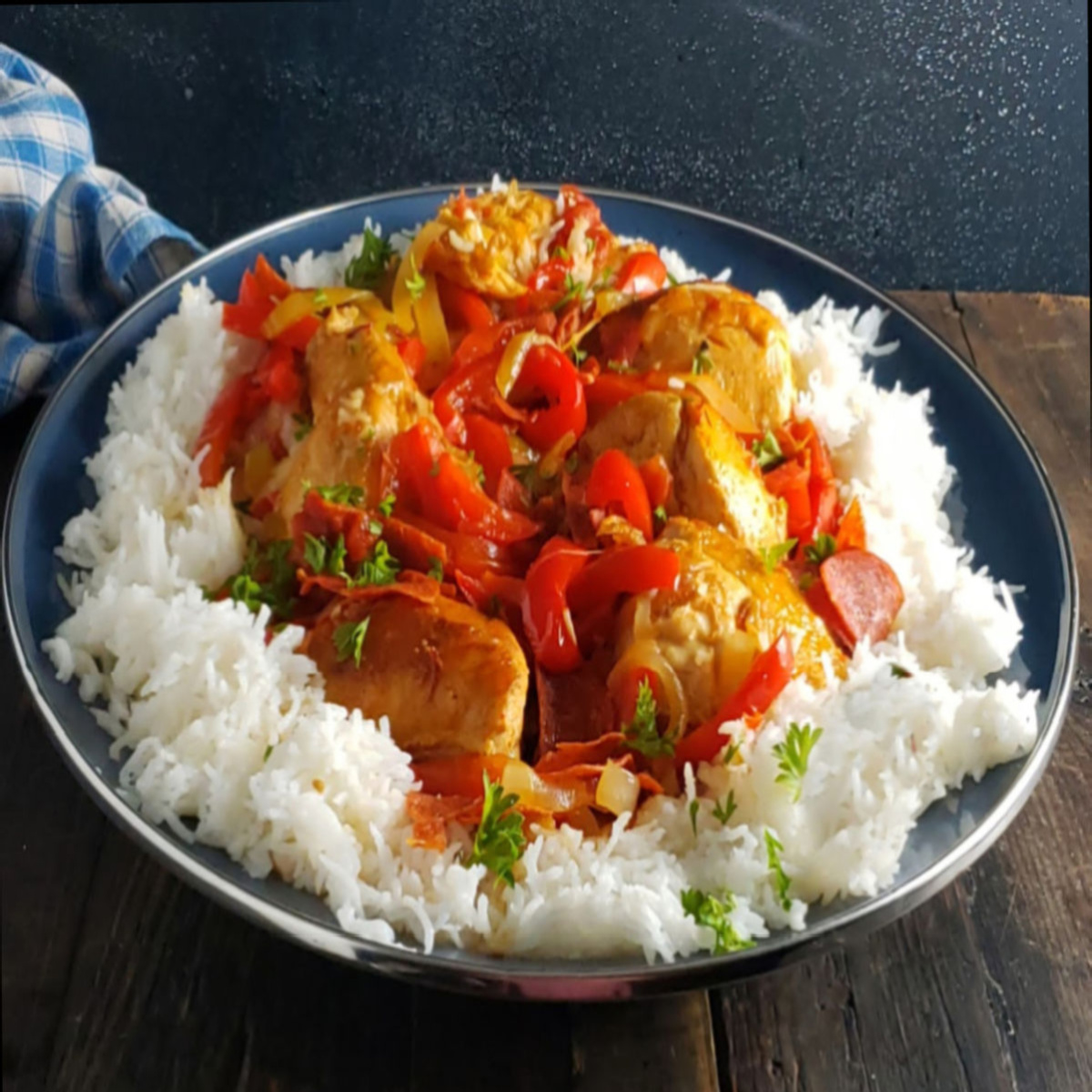

Let’s take you back to 1969: Jack LaLanne was on every afternoon, followed by the very dashing Galloping Gourmet. We know him today as Graham Kerr, and in my mind’s eye, I can still see him flitting about the kitchen. On this day, he was making Poulet Basquaise – Basque Chicken.


My Sis talked my Mom into writing it down. Just think, if she had written down one of Jack LaLanne’s fitness routines, we’d probably all be buff. Instead, we all cook. No one cares, though, when they tuck into this incredible chicken dish!
About Poulet Basquaise – Basque Chicken:
Poulet Basquaise is a traditional dish of chicken pieces (and sometimes sausages, or other items) braised in a hearty saucy mess of red and green peppers, onions, and tomatoes. It’s basically a stew, and best served over rice to soak up all the gorgeous juices.
Poulet Basquaise originated in the Basque Country, straddling the border between South Central France and Northwestern Spain in the Pyrenees. I recognize elements of both countries in this super flavorful dish.

Basque Chicken – so outstanding! And so easy!
About Recipe Changeups:
Graham Kerr took a cheffy approach and added wine and Csabaia sausage (it’s Hungarian) to his Basque Chicken. Being from small-town Iowa, Mom riffed and used a good pepperoni she sliced herself. Even packaged slices will work in a pinch.
With better resources and a little more scratch, choose a sausage from the Basque Region. This recipe is regional; every family will have their take. Some only use chicken, some include sausages, and I’ve seen a few made with small bits of ham. You do you.
I streamlined the recipe; it’s all in one pan. I love the sweeter, more stunning red peppers instead of the green, but I usually use one green pepper or two hatch chiles as well. Optional smoked paprika is added to the recipe, and if I have it, a pinch of saffron is transformative. Yes, even from a frugal blog! A few threads go a long way!
I’ve always made this recipe with Pinot Grigio or Sauvignon Blanc, which are my go-to white wines for cooking; cooking is a great way to finish an open bottle. The Basque Country is famed for its wine, if you have access.


Making Poulet Basquaise – Basque Chicken:
Making this recipe is straightforward, but I’d like to bring attention to the following points.
Trim today’s huge chicken breasts (sometimes 12 to 15 ounces each) into appropriate sizes, five to six ounces. Huge breasts throw off the timing and won’t fit in the pan. Cut large ones in half, right through the bone. If strength is an issue, tap the knife with a mallet (maybe don’t use your best knife!)
If you want to use chicken thighs or legs instead of bone-in breasts or wish to use boneless breasts, which I often do, give the pepper and tomato mixture a three or four-minute head start.
This recipe taught me the art of “fortifying”, using ingredients at the beginning and the end to build flavor. Hold back 1/2 of the tomatoes and a 1/4 cup of the wine and add them at the end of the recipe.
There’s a lot (by American standards) of good, healthy olive oil for richness and flavor. Make sure you like the taste of your olive oil! Some are stronger, some mild, some grassy, some more buttery, and some bitter.


To Skin the Tomatoes:
- Make a small X across the bottom center and drop in boiling water for one minute. The skin should wrinkle at the edges of the X.
- Immediately remove, place in ice-cold water to cool. Catch the skin between your thumb and a small knife. It will easily pull away.
Serving:
- Our family places rice on a large platter, makes a well in the center, and adds the chicken. The pepper/tomato mixture and juices are spooned over the top.
- If all the pepper/tomato mixture doesn’t fit, just serve any extra on the side.
Storing and Reheating:
Store in the fridge, tightly covered, three to four days. While not as attractive, the flavor is even better the next day.
Reheat slowly, either in the microwave (try the defrost setting and turn the chicken in the sauce now and then) or on the stove.
To freeze, remove the chicken from the bone and store it mixed with the peppers. Thaw overnight and reheat the next day.
Saving Money on Poulet Basquaise – Basque Chicken:
- Chicken: Chicken regularly goes on sale, so make it a habit to know the lowest price it drops to and what’s a good buy in your area. Break it down into packages that suit your family size and freeze. There’s no need to ever pay full price!
- Bell Pepper: Bell peppers can be super pricey! Know both When (in season or on sale) and Where (discount stores like Aldi or Lydl or maybe your buyer’s club) to buy them. If you’re budget-minded, use green peppers.
- Tomatoes: Any tomato will do, but this is a great recipe to use imperfect farmer’s market or garden tomatoes. Since they are cut, any imperfections are easily removed. At the very least, buy on sale! In a pinch, sub in canned; use more because they are smaller.
Wine:
- Sign up for emails, watch flyers, and shop the sales, including the bargain bins. There are two major sales in the industry, fall and spring. Stock up. Additional discounts usually apply when buying in bulk; if not offered, ask.
- Talk to the wine person, consultant, guide, or sommelier. A good one will ask your price range, what you’re making, and direct you to options you may not have thought of or known about.
- Cooking is an ideal way to use a partial bottle; store in a small, airtight jar until needed.

Serve on a big platter of rice! Pass any of the peppers and juices that don’t fit!
Poulet Basquaise – Basque Chicken

- Prep Time: 20 minutes
- Cook Time: 35 minutes
- Total Time: 55 minutes
- Yield: 6 servings 1x
- Category: Main Chicken
- Cuisine: Basque
Ingredients
- 1/4 cup olive oil
- 4 bone-in chicken breasts, cut in half if over 10 to 11 ounces
- salt & pepper
- 3 to 4 ounces diced pepperoni (originally Csabai) or pepperoni slices, roughly chopped
- 3 to 4 bell peppers, sliced thinly (try 3 red and 1 green or sub 2 Hatch chiles for the green one)
- 4 large tomatoes, skinned, deseeded, and chopped, divided in half
- 1 large garlic clove, crushed and minced
- 3/4 cup of dry white wine, divided in 1/2 cup and 1/4 cup (recommend Pinot Grigio or Sauvignon Blanc)
- 1/2 to 1 teaspoon smoked paprika, optional; go by taste
- good pinch of saffron, optional
- 2 tablespoons of chopped parsley, divided, optional
Instructions
In a large Dutch oven, heat olive oil over medium-high heat, season breasts with salt and pepper, and add chicken breasts to the hot oil. Turn heat down to medium and brown slowly on all sides. When ready to brown the final side, add pepperoni. Continue to cook until the chicken is golden on all sides and until fat is rendered from the pepperoni, then add garlic and saute until fragrant.
Remove the chicken and add peppers, 1/2 of the tomatoes, and 1/2 cup of the wine. Add in the smoked paprika and saffron if using. Stir and return chicken to the pot. Cover and bring to a simmer for about 20 minutes, until chicken is just done; a fork should easily pierce through to the bone in the thickest part of the chicken. Remove the chicken to a platter and tent to keep warm.
To the skillet, add in the rest of the tomatoes and the remaining 1/4 cup of wine and simmer for a few minutes to concentrate the sauce; keep an eye on the peppers. The dish is basically finished when the peppers and onions are tender; if overcooked, the skins may separate from the rest of the pepper, which makes it unattractive. Stir in half the parsley.
Serve the chicken over a bed of rice topped with the pepper mixture and pan juices. Garnish with remaining parsley.
Cal 665, cal from fat 50%, tot fat 36g; sat fat 9g; chol 152mg; sod 1535mg; pot 1871 mg; tot carb 26.23g; fib 7g; sug 16g; prot 50g

Pingback: Saint Ignatius of Loyola Feast Day | Catholic Homebody