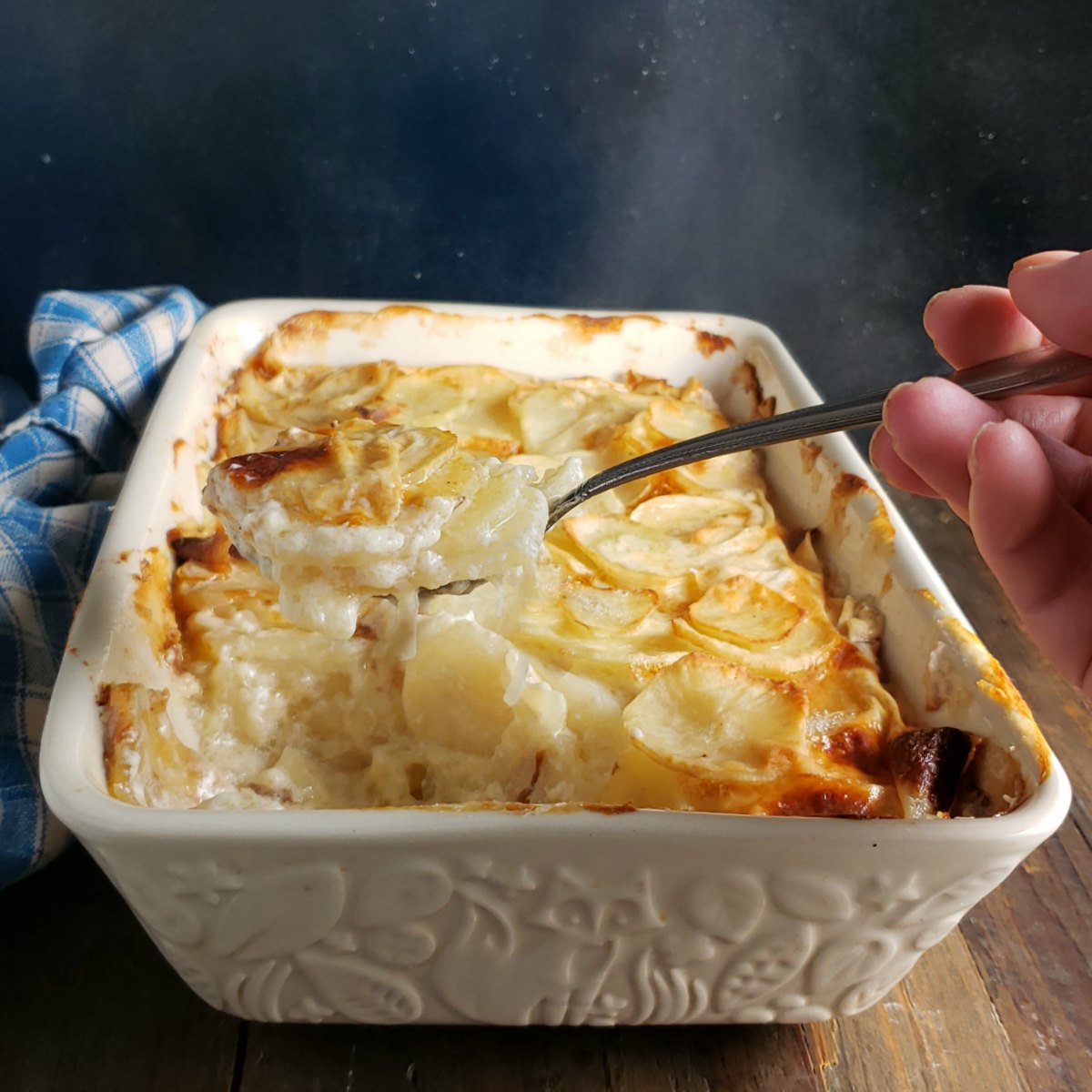
On my site already is a recipe for Scalloped Potatoes Like Your Grandma Made. I love those, and they are def a go-to at my house, especially after any holiday with ham (when I often sprinkle in both cheese and ham between the layers). However, if you examine that post and delve into the comments and discussion, you’ll see that many asked for the recipe for these Old-Fashioned Scalloped Potatoes – they strike a huge nostalgic note.

Scalloped potatoes predates the other recipe, the “Grandma” potatoes, maybe by decades. Deb asked about these the other day, so I hope you’re following! Thanks to you, I was “forced” to eat two big helpings of this last night, lol!

While it’s still piping hot, run a knife around the edges and be sure to rest a few minutes before serving.
The ingredients for both recipes are almost identical; it’s the method that differs. The flavors for both are classic: Potatoes, milk, and butter, flavored with just a little onion, along with salt and pepper. Unlike this recipe, the “Grandma” potatoes relies on a white sauce.
This one is creamy but not quite as “saucy.” Both are good, plain home cooking. There’s something to be said about letting the flavors of good food shine for what they are.
About Old Fashioned Scalloped Potatoes:
So if you want a good old-fashioned scalloped potato, this is THE recipe. The one that’s going to take you home. To Mom, to Grandma, maybe sitting around that old Formica or white wooden table, maybe to the country.
And maybe “home” is 50 years ago, like it is for me, or maybe longer for others. It makes no matter; when these creamy potatoes, delicate with just a bit of onion to the flavor and buttery richness throughout, hit the table, home is right here, right now.

This dish bubbles up unpredictably sometimes but those edges are the best part!
Scalloped vs. au Gratin:
Scalloped:
- Scalloped potatoes (or scalloped anything) means the dish is either cooked with milk or cream.
- The items are layered in “scallops”, or shingled in the dish. Think of a lacy dress trim that is scalloped.
- Other examples are actual scallops (some think the name comes from these), tomatoes, and some meat dishes.
Au Gratin:
- Au Gratin potatoes (or anything au gratin) are traditionally baked in a shallow dish, sometimes topped with cheese and/or breadcrumbs, and allowed to brown to a beautiful crust.
- The name has become synonymous with the dish, which is traditionally a shallow, oval dish that allows for maximum browning.
- A classic example is Gratin Dauphinous, which forms a beautiful crust with no cheese or breadcrumbs, but there is no end to recipes baked au gratin.
These days, you’ll find Cheesy Scalloped Potatoes, sometimes topped with cheese and au Gratin Potatoes (check out my Ruth Chris’ Copycat Recipe) that use cheese throughout and/or are made with cream and then topped with cheese. These “hybrid” dishes are more of a new American tradition.


Varying Old Fashioned Scalloped Potatoes:
Some variations are Midwest Americana cooking (this has the same Germanic roots as so many Midwesterners), and some are more “today.”
Don’t add too much to these potatoes. Use a good amount of salt (I eyeball about a teaspoon) and just a bit of pepper. Some like to add a whisper of nutmeg or a pinch of cayenne, not enough to flavor, just enough to add an elusive back note.
Garlic powder or seasoning salt is sometimes added. Others take this to the German side and add dried mustard, or celery, or the stronger caraway seed. I can’t get behind it; I love these as is.
A little cheese can go on the top, but the method of assembly, layering potatoes with butter and flour, then pouring milk over all, won’t support cheese in the dish without “breaking.”

Even when there’s lots of room, you might get boil over! Put something under your dish.
Make it a Meal:
This is a dish classically paired with pork. It’s fabulous served with Ham, pork chops, or browned sausages: Smoked sausage or links like bratwurst. Small bits of ham can be added between the slices of potatoes.
Cooking pork chops on top is a classic. Use thinner pork chops; check out family packs; bone-in is better, and nothing too lean. Just salt and pepper them, and add them to the top when the potatoes are uncovered. Turn the chops halfway through the remaining hour. Not pretty, but delicious.
Making Old Fashioned Scalloped Potatoes:
These are fast and easy to assemble and pop in the oven.
The Potatoes:
- Russets are best. The starch in the potatoes helps with the creaminess. Do not sub in a waxy potato.
- Use two to two and a half pounds. Two pounds (what I used in the photos) are rich and creamy. Two and a half gives a more solid dish.
- That will be about five to six medium potatoes. If you can’t weigh, guestimate by looking at the number of potatoes in a package and removing an appropriate amount.
- Use a food processor or a mandolin to speed the slicing along and for more uniform slices.
Onion:
- Any onion will do. Sharper white onion is classic, but yellow is fine.
- Cut the onion in half and slice very thinly into half moons. The half moons allow the milk to seep into the spaces they provide, better to meld the milk, flour and butter. They disappear once cooked.
The Flour and Butter:
Be careful with the amount of butter. More might seem better, but it can break and make the dish greasy.
While it’s normal for this dish to clumpy, it should be creamy throughout. Some use Wondra (a fine flour) instead of all-purpose. It dissolves better and prevents clumping.
The Milk:
- Use full-fat whole milk. A little half-and-half or cream can replace part of the milk. Heat the milk and pour it very slowly and gently, making sure to hit the top of each potato.
- Once poured, take a knife and ever so gently, without disturbing the layers, nudge the potatoes here and there to help distribute the milk.
Helpful Hints for Cooking Old Fashioned Scalloped Potatoes:
The hot milk and high oven temp kick start the cooking process, making sure there will be no residual “flour” taste once the dish is finished.
Cover with foil for the first 20 minutes (it gives the potatoes a head start) and then uncover. Even with room between the potatoes and the top of this casserole, it often spills over. Place that same foil on the shelf below the casserole. If still in good shape, use it to cover any leftovers. (Less waste.)
Know your oven. Baking at too high a temperature can cause a curdled appearance. If your oven runs hot, adjust the temperature down. A save is to pour in a touch more milk, nudge it around, and bake another 10 minutes or so.

Saving Money on Groceries:
What you pay for groceries depends not only on WHERE you shop, but WHEN. Be strategic and stock up at rock-bottom prices.
- The best sales are before holidays; check out Win at the Grocers. Use these sales not just for your holiday, but to stock up at a low for the coming weeks to months.
- Take advantage of discount stores like Aldi or Lidl. The pricing at Buyer’s clubs is not always the lowest, but can trump in quality; be selective.
The best way to save money on this or any recipe is to have a well-stocked pantry, fridge, and freezer full of sale-priced items.
Russet Potatoes:
- Check your discount stores for low prices, buyers’ clubs for great value. Larger bags are cheaper per pound unless there’s a great sale on another size. Don’t pass on “dirty” potatoes. They’ll actually store better.
- The largest bags might have a mix of sizes; separate the larger for recipes using whole potatoes; reserve others for when size doesn’t matter.
- Think seasonally; although never expensive, russets are in season and at their lowest from late summer through winter. Take advantage and use more often.
- A large russet runs about 8 ounces, a medium about 5 ounces, a smaller one a few ounces less. Larger packaged bakers aren’t a good value; save for special occasions and pick them up at your buyers’ club.
- Once home, store in a dark, cool, dry area, well-ventilated, away from onions. Remove from plastic. A paper grocery bag with the top folded is ideal. It keeps them in the dark and reduces condensation.
Basic Veggies:
- Basic veggies like onions, celery, and carrots are some of the cheapest. For best pricing, try the discount stores. Bags are generally better deals than loose.
- Store onions in a cool, dark, well-ventilated place, away from potatoes.
Butter:
If you have a deep freeze (and you should if you can swing it), there’s no reason to buy butter at full price. It goes on sale often and keeps well.
- While on sale before any holiday, rock-bottom pricing is before the Winter Holidays, and often matched by sales before Easter. Count out the weeks between holidays and buy appropriately.
- Discount stores have great pricing on butter year-round (and sale prices before holidays).
Milk:
- Discount stores usually have the best pricing, buyer’s clubs next, and sometimes it’s on sale at the grocery. If that’s the case, buy at the beginning and end of the week.
- Don’t confuse “best if sold by” or “best if used by” dates with spoilage; these are not safety dates, and milk is generally good around ten days past the sold by date if unopened. Use your nose! Keep it capped and refrigerated on the bottom shelf, not the door, and don’t leave it hanging at the table while eating – it will last much longer.

Old Fashioned Scalloped Potatoes
Old Fashioned Scalloped Potatoes

- Total Time: 1 1/2 hours
- Yield: 6 to 8 servings 1x
- Category: Hearty Side
- Cuisine: German
Ingredients
2 to 2 1/2 pounds russet potatoes, peeled, thinly sliced into circles
1/2 small onion, sliced in half, then into thin half-moons
3 tablespoons flour, divided
1 teaspoon salt, divided
1/4 teaspoon black pepper (optional), divided
3 tablespoons butter (about 1/2 tablespoon for pan), the remainder divided
3 cups milk, preferably whole, heated
Instructions
Preheat oven to 400 degrees F. Generously butter a 2-quart casserole (use about 1/2 a tablespoon of butter.)
Add about 1/3 of the potatoes to the bottom of the dish, sprinkle with 1/2 the onion, a tablespoon of flour, then with a little of the salt and pepper. Dot the layer with small bits of butter totalling about a tablespoon. Repeat the layer. For the top layer, shingle in the potatoes, sprinkle with flour, salt, and pepper and dot with butter.
Gently pour milk over the top layer in a light stream; aim to pour some milk over each potato slice on the top layer without washing off the flour mixture. If needed, take a thin knife and nudge the potatoes around so the milk can flow through.
Cover with foil and place in preheated oven. Set timer for 20 minutes. After 20 minutes, working quickly so as not to lose heat, remove foil (foil may be placed on the rack under the potatoes to catch any drips if desired), turn oven down to 350 degrees F. Continue to cook for another 50 to 60 minutes until potatoes are tender throughout when poked with the tip of a knife and top is browned to your liking.
After removing from oven, run a knife around the edge of the potatoes to loosen them from the pan; it will prevent the browned crusty bits from staying behind as you serve. This is best if allowed to cool for several minutes before serving to allow to set up.
Note:
- Measure the butter out first, butter the pan, then divide the remaining into approximate thirds so you’ll know how much goes on each layer.
- It is easiest to get even coverage on the flour, salt, and pepper by mixing them together in a small bowl and then sprinkling each layer. You’ll need a little more than a tablespoon per layer if you mix.

70 thoughts on “Old Fashioned Scalloped Potatoes”