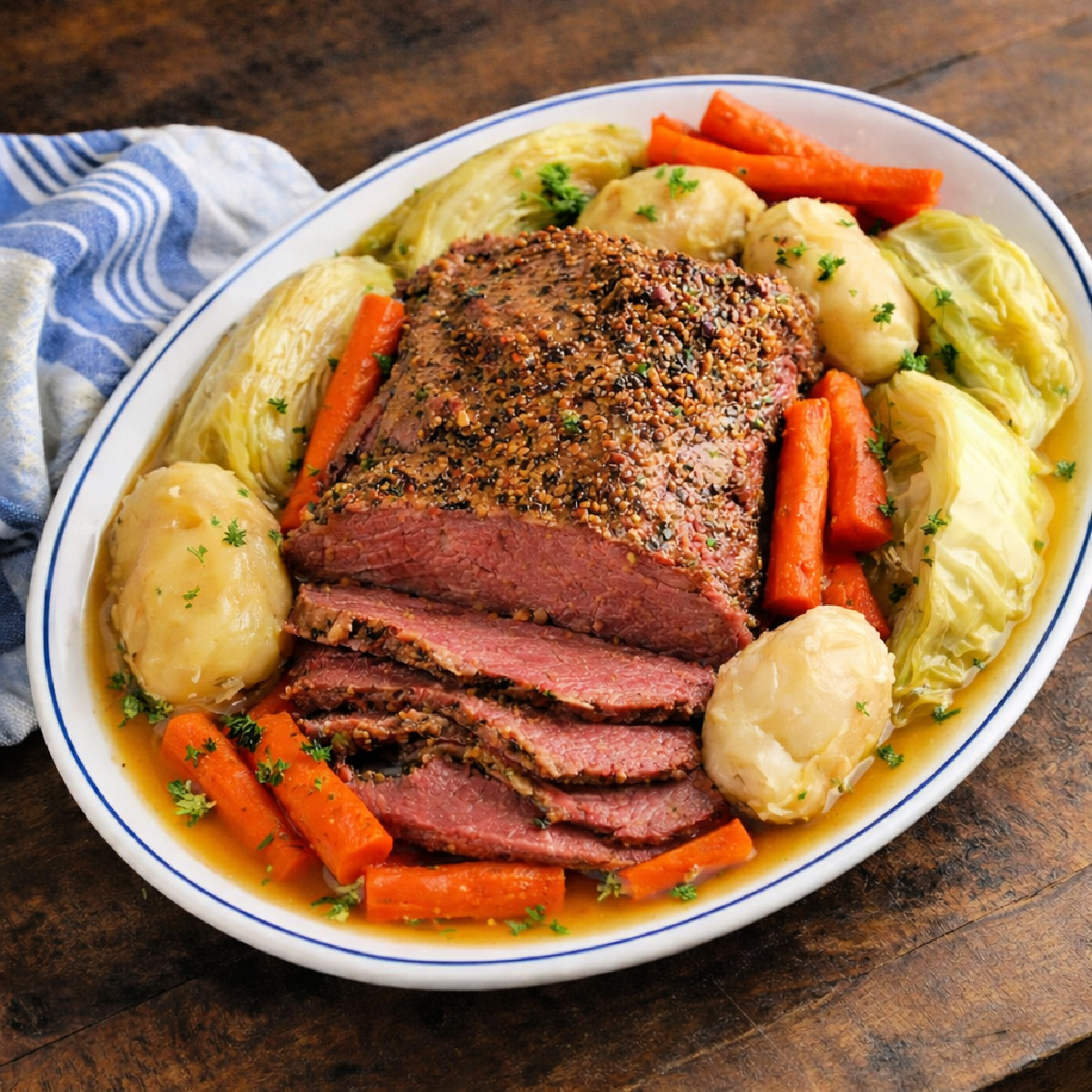

I get super psyched over St. Patrick’s Day! It’s not the parades that get me going, it’s not the partying: It’s the Corned Beef Cabbage Dinner. I love love love me some of that luscious, briny Corned Beef and the potatoes, carrots, and cabbage that go with it. All those veggies flavored by that broth. Heaven!!

Corned Beef and Cabbage Dinner

I grew up in a very Irish town in Iowa, and St. Patrick’s Day was a big thing. And while there were many activities centered around the Church, it was really the canny businessmen in town that got things going as far as St. Paddy’s Day. And one of the most popular events was a Church Basement Corned Beef Dinner.
About Corned Beef Cabbage Dinner:
I went with my friends, and it was my first introduction to Corned Beef and Cabbage. I don’t remember the looks or the smell being too promising – but that first taste? Life-changing!
But before we get to the cooking, is Corned Beef Cabbage Dinner really Irish? Well, it is, and it isn’t! Read more about it in this Smithsonian article. You might just be surprised. Personally, I think it’s related to Spiced Beef, but until recently (thank you, Internet), no one I’ve ever known had heard of it.
Simmering Stovetop vs Slow Cooker:
Once I moved away from home, I had to learn how to make corned beef & cabbage on my own. Being a working Mom, and with St. Paddy’s seldom falling on a weekend, I started out, like many of you, I’m guessing, with the crock pot version. Let me tell ya, the neighbors in my building were not too happy with the aroma – one even met me at the door to let me know!
I still use the slow cooker version (included below) now and then. I love this Instant Pot Corned Beef & Cabbage, too, which has exceeded all expectations. I’m also loving on this Glazed Corned Beef and Cabbage, adapted from the Silver Palate.
But hands down, my favorite way to make Corned Beef and Cabbage is to simmer it on the stovetop. It takes a while, a few hours, depending on the size of the corned beef, but in a heavy Dutch oven, it’s pretty much hands off. The payoff for such little effort is amazing!
Simmering the Corned Beef concentrates the flavor, and of course, you have a lot more control over the vegetables: each can be added in turn, so they are all cooked beautifully. When the veggies are on point, it takes the meal from drab to world-class. (That’s a little more difficult to pull off in the slow cooker.)
Whether you decide to go with the Slow Cooker or the Stovetop version, below, I have a special little twist in the spicing that will take your Corned Beef Dinner over the top.


Choosing the Corned Beef:
Your basic Corned Beef from the grocery is brined in a solution of salt, spices, and herbs. While the spices may vary from producer to producer, they’re similar to the spices used in pastrami, and usually the corned beef will come with a packet of pickling spices that can be added to the cooking liquid.
Corned Beef has a unique pink color, from the pink-curing salt, sodium nitrite, used in the process. While it does extend the storage time, Corned Beef is fresh meat, so pay attention to the recommended amount of time to keep it in the refrigerator. It freezes well.
The cut is from the brisket, and the brisket is composed of two muscles, the flat and the point.
- The flat is preferred for corned beef; its rectangular shape is fairly even in thickness and slices well. Usually, there’s a generous fat cap, which might or might not be trimmed as it’s processed for corned beef.
- The point (named for its triangular shape) sits on top of the flat and is usually separated when processing. It tends to be very fatty, and once cooked, it can make the broth, as well as any vegetables cooked in it, greasy. Avoid this cut if possible.
Corned beef shrinks considerably when cooked, almost by half. It can be difficult to find one over 3 1/2 to 4 pounds. Count on about 3/4 to a pound per person, depending on appetite and whether you want leftovers or not.

Corned Beef and Cabbage Dinner
Making Corned Beef Cabbage Dinner:
There is hardly anything easier to make than a Classic Corned Beef Cabbage Dinner, but there are a few details to pay attention to.
Rinse the Corned Beef: Rinse the corned beef. It removes any overly salty jelly-like substance from the brine.
Trim: The top of the brisket (the flat) is usually coated with a layer of fat. While some will melt into the beef and the liquid, making both luscious and tasty, if it’s thicker than about 3/8ths to 1/4″, trim it down.
Potatoes: Use red potatoes (the classic) or something along the lines of a Yukon gold, and peel or not as you wish. A russet can be used in a pinch, but should be peeled. If the potatoes aren’t uniform in size, cut the larger ones down so they’re about the same size as the smaller ones – that will help them cook evenly.
Carrots: As a general rule, choose larger carrots; you may have to buy a larger bag to get them. Peel them, and when cutting, think “volume,” trying to cut so that the thicker ends are a little shorter, the slender ones a little longer. Slice the larger ends in half if necessary.
Cabbage: Wedges about 2 1/2 to three inches wide are a great size, so cut accordingly; the number of wedges will depend on the size of the cabbage. Cut to keep a bit of the core along the edge of each piece. It will help hold the cabbage together. Once cooked, the larger slices will stay a little firmer, and the thinner ones will become pretty soft.
Timing: When cooking stovetop, count on 45 minutes to an hour per pound, depending on the size and shape of the corned beef. Slow cooker versions take much longer, 8 to 9 hours on low. Cooking on high is not recommended – the long, slow cook will produce the best results.
Special Touches:
Corned Beef usually includes a small packet of pickling spice.
- It’s helpful when using a slow cooker. The larger amounts of liquid generated when using a slow cooker can use a boost in flavor.
- When simmering stove top, don’t use it – the more concentrated flavors would be overwhelming if the packet is used. (I usually save it, after washing the outside of the packet, for a batch of quick pickles or pickled beets.)
Additional Spices:
- Whether cooking in the slow cooker or stove top, I always add a little thyme, a touch of mustard powder, and an onion studded with four (no more – the flavor is strong) cloves.
- Mustard seed is included in the pickling spice, but a bit of powder boosts the flavor slightly – don’t worry: the finished corned beef won’t taste like prepared mustard.
- The onion, added at the beginning, holds the cloves; you won’t need to go “fishing” for them. At the same time, the onion adds flavor and a little thickness to the broth. Once finished, the onions all but dissolve into the broth.
Corned Beef Cabbage Dinner & Leftovers
These days, corned beef seems to come in smaller packages, but if you can set a little corned beef aside to come back to the table another night, you’re able to “cost average” that brisket over two meals or more.
While the Corned Beef will be the star of the show the first night, it will take on a secondary role the second. Here area few of my favorite leftover corned beef recipes, but check out 40 Recipes for St. Patrick’s Day for more.


Saving Money on Corned Beef Cabbage Dinner:
As far as cost, Corned Beef isn’t always the cheapest of meats, but Corned Beef will be on sale before St. Patrick’s Day, so watch closely, and you’re likely to find some decent pricing. Depending on how the stores in your area handle the excess after the holiday, you may be able to pick a couple up for dirt cheap after the holiday.
See my post on Saving on St. Patrick’s Day for what you are likely to find on sale before the holiday. Most of the items for the dinner and almost anything remotely related (including some fish and seafood) will be dirt cheap.
Compare pricing if you come across those bags of veggies on special for St. Paddy’s Day. Sometimes the bagged “specials” might be more (or at least more per pound) than buying potatoes, carrots, and cabbage on their own.
Leverage sale pricing to pick up extra items for the future. Potatoes, carrots, and cabbage are going to be at the lowest price until fall, and they keep well for at least a few weeks. Stock up and use them more while they’re cheap.

Corned Beef and Cabbage Dinner
Corned Beef Cabbage Dinner

- Prep Time: 15 minutes
- Total Time: varies
- Yield: 4 + servings 1x
- Category: main dish beef
- Cuisine: Irish
Ingredients
- 4 pounds Corned Beef Brisket, rinsed, spice packet used if Slow Cooking
- 2 large onions, one peeled and studded with about 4 cloves, the other peeled and quartered through the root end
- 4 cloves (for the onion)
- 1 sprig thyme
- 1 teaspoon dry mustard
- water
- 5 to 6 medium-sized red potatoes, peeled or not (about 5 ounces each, more if smaller) The Irish rule is “one per person and one for the pot.”)
- 4 large carrots, scraped and cut into about 4-inch chunks, larger ends halved
- 1/2 head of cabbage, cut through the root end so slices remain intact
- parsley, optional for garnish
Instructions
Stovetop:
Rinse Corned Beef. Trim any excess fat cap, leaving a layer of fat across the top. Put meat in Dutch oven with onions. Add the thyme and sprinkle with mustard powder. Add water, pouring down the side of the pan, not over the corned beef, to a level of about 3/4 up the sides of the corned beef, Don’t cover the corned beef. Bring just to a boil and immediately turn down to a simmer. Skim off any foam.
Add a lid and simmer very gently (small bubbles popping up here and there on a regular basis) for about three hours. Add the vegetables, cabbage on top and simmer gently another hour. The liquid level may need to be checked during the long simmer.
When finished, the Corned beef should be tender but not stringy and falling apart, the internal temperature should be 190 to 195 degrees. Rest for 15 to 20 minutes before cutting into thin slices across the grain. Serve on a platter with the vegetables. Pour a little of the broth over the corned beef and vegetables and pass the remaining. Garnish with parsley if desired.
Note: If you’d like a lot of vegetables, cook the corned beef until done, remove to rest, then add as many vegetables as you can fit in the pot, potatoes on the bottom, cabbage on top. Cover and simmer briskly for 25 – to 45 minutes (depending on the size of the vegetables) until vegetables are tender.
Corned Beef in the Slow Cooker:
If you need to cook this in a crockpot, prepare as above and add the rinsed Corned Beef on the bottom along with the onions. Add thyme, sprinkle with mustard powder, then the contents of the spice packet. Then either:
- If the meal needs to be completely ready: Add the potatoes, carrots, and cabbage, in order, on top. Add enough water, pouring down the side of the slow cooker, not over corned beef to just cover the corned beef. Set it on low and leave for eight to nine hours. The meal will be finished but the vegetables will be very tender, nearly falling apart. Depending on the crock pot some may be seared to the sides.
- If there is time to finish in the evening: About 40 minutes before ready to eat, remove the corned beef, tent to keep warm. Turn the slow cooker to high, then add the vegetables in order, the potatoes on the bottom. Add the lid and leave for about 45 minutes to an hour, or until tender. When ready to serve, remove the vegetables, turn the slow cooker off, slice the corned beef across the grain, and return it to the slow cooker for a few mintues to heat through in the broth. To speed things up, broth may be added to a pan and vegetables simmered on the stovetop.
For all Versions:
Serve on a platter with the vegetables, pour a little of the broth over, and pass the remaining. Garnish with parsley if desired.
Notes
If serving 4, there should be a few leftovers.
The general rule of thumb for braising different weights of corned beef: count on cooking one hour, then add then add an additional 45 minutes per pound. Smaller cuts may need slightly less time.
