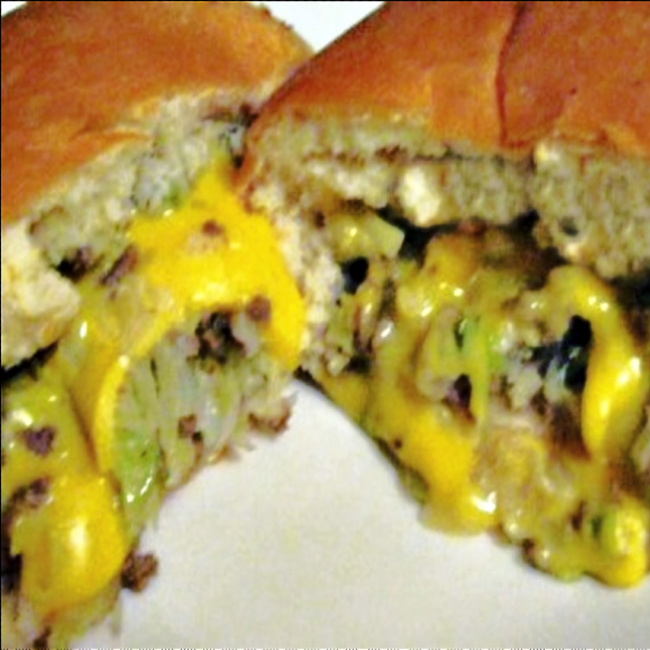

When my baby Sis posted that she was making her Runza (Bierock) Recipe, I became inspired. She (and her family) fell in love with them during her years in the Cornhusker State, and my Sis knows her Runza.

If you’ve never had a Runza, you’re in for a treat. It’s a beautiful, light, fluffy bun wrapped around a filling of ground beef, cabbage, and onion. They’re good old-fashioned cooking with the emphasis on good!
About this Runza (Bierock) Recipe:
Originally “peasant” food, the Runza (Bierock) was brought to settlements in the Midwest by immigrants who came originally from Germany, by way of Russia, where they had settled in the lower Volga region. Eventually, the first Runza restaurant was opened in 1949, franchised, and the name Runza was copyrighted (hope I don’t get sued), although a commenter mentioned that “Runza” was in use long before. Others mentioned these are sometimes called Kraut Buns or some close variation.
While the exact history of the Nebraska Runzas (Bierocks) may never be known and is still under debate, it seems they clearly were made from various types of leftover meat, minced and saved until there was enough filling, then combined with either cabbage or sauerkraut. Today, ground beef is usually used. Everything else seems to be up for debate.
When I finally hit on the exact combination of filling and dough for my Runza that my son and I both loved (he and his friends say they taste like White Castle Burgers, which may or may not be a compliment), I knew this recipe was ready to. Let me answer any questions you have first, or just use the “jump to recipe” button above.
What Seasonings are Used in Runza (Bierock)?
Historically, salt and pepper, and many (including my Sis,) emphatically deny the use of anything else~! I felt something was missing, and read online that some people claim white pepper as an ingredient, but then I came across a photo of a Runza from the chain.
The color was a dead giveaway. There’s allspice and/or clove! That’s in keeping with spices from the Volga region. Many people online have said that the flavor of the Runza is elusive and can’t be duplicated…I think they’re just missing allspice.
I went through a process getting the spicing just right. I added both white and black pepper with some allspice; for the next batch, I added more. By the third batch, I added a bit of clove along with the allspice – about 1/4 to 1/2 teaspoon, tasting as I went along. I think it’s spot on.
Interesting to me is that several commenters have mentioned using oregano. I might hazard a guess from the area these came from that marjoram (similar to oregano, some say) might have been used, and way back when might have been harder to find in the U.S.

A Runza with Cheese from the chain. Note the coloring, a dead give away it contains spices.
What About the Dough? Can I Use Frozen Bread Dough or Rolls for my Runza (Bierocks)?
- Traditionally, a sweeter dough was originally used, and this is seconded by commenters. The dough here is a little sweet, and it’s easy and forgiving as far as bread-making goes. The bit of sugar helps with the quick rise, too.
- But yes, you can make this Runza (Bierock) Recipe using frozen bread dough or frozen rolls. No judgement here! It’s better to have a semi homemade Runza than no Runza at all!
- Frozen rolls are probably the easiest, and you can use a method where you put a hole in the dough, stuff it, and then seal it. I weighed my homemade Runza dough, and it came out at 2.6 pounds, which made a dozen Runzas for me, so you might need more than a pound of rolls – but I think there’s usually a dozen rolls in a package, so you might want to just “roll with it.” So sorry, couldn’t help myself!
Should Bierocks have Sauerkraut or Cabbage? What about other Vegetables?
- It seems that Cabbage is the overall winner according to my commenters, and some do add in sauerkraut along with or instead of the cabbage.
- Commenters have commented using a partially cooked potato, added to the pan with the beef, and broken down. It helps to make the filling hold together and stuffing easier.
- Shredded carrot seems to be another traditional addition, and if you read through the comments, the more adventurous add mushrooms. I say make them how you would like them! And I’d love to know your variations!
About the Cheese:
Should there be cheese, and if so, what kind? Does the cheese go in before or after baking?
- While not traditional, it seems that the Runza restaurants serve these with or without cheese, and it is added before baking.
- My Sister is of the opinion that no Runza is complete if it’s not opened up after baking, so a piece of American cheese (like the singles) can be jammed in to melt. Some Volgan grandmother must be rolling in her grave (but I have to admit it’s good!)
- Readers have mentioned adding grated cheese to the filling, and several have mentioned other types of cheese other than American or Cheddar. I think Feta was mentioned more than once.
What Shape Should the Runza (Bierock) Be?
How thin/thick should the dough be? Should they be small or large? Should the shape be a half-moon, a bun, a square, or a rectangle? Anyway you go, make sure the seams are on the bottom. Let rise, then pick up and check the seals before baking. I found a square was easier (for me) to fill and shape than a bun, rectangle or moon shape.
- A square: I like to know that a recipe will have just enough dough and filling, and I am using a good amount of that filling. I rolled the dough out and measured, then cut with a pizza roller and made them “assembly line style.” I pinched the seams; I didn’t want to pull up the dough corner to corner and pinch in a knot. I was afraid the dough would be too thick on the bottom.
- A bun: You could divide the dough in half, then in half again, then take each section and divide it into 3. Then make a hole and stuff. I found this really messy, and I had a lot of “leakers” even when I thought they were perfectly sealed.
- Half Moon: I haven’t tried, but I imagine you’d start out making the bun version, then coax it into shape after it’s filled and sealed.
- A rectangle: This is how the commercial Runza is made. Someone in the comments gave some direction.
As for size, if you’re not making a dozen, either more or less, you’ll be changing the amount of filling for each, and the size, and have to watch the baking time closely.
Making The Filling For the Runza (Bierock) Recipe:
When you make the filling, be sure to cool it, drain it well, and once drained, season it. The filling should be very well seasoned. Cabbage loves pepper! Add how much pepper you think you need, then maybe even add a little more.
Then add the other spices in the recipe, or riff as you like, and of course, taste as you go. That’s how you’ll get your perfect filling!

A Potato Masher makes short work of ground beef, turkey, chicken or sausage and doesn’t cost 16 bucks!
Making The Bread For Runza (Bierock) Recipe:
If you haven’t made much bread, this is the recipe to try! You’ll look like a hero – plus, any imperfections are charming, amirite? They just scream out “homemade!” The dough is so easy that it can be made by mixer or by hand.
The homemade dough tastes like a dream. It is very distinctive, light and fluffy, with a slightly sweet taste, kind of like a Hawaiian Roll. It was perfect with the filling that had the allspice and clove, but it seemed a big odd with the filling that didn’t contain those spices. (At least until that cheese was added, which was a game changer.) It seems like the spices and bread balanced each other.
I tested multiple times with varying amounts of sugar. With less sugar, it took forever to rise and baked up a little dry and crusty, not a perfectly soft roll. More than half a cup was just too much.
Rising:
I let the Runza rise right on the baking tray, covered with a towel for about 20 minutes while my oven preheated, although that time can vary depending on how warm your kitchen is. If it’s winter and the kitchen is cold, spray the first with a little cooking oil; it will keep the dough supple for a longer time it will take to rise.
They do need to rise enough so the top is smooth. They don’t have to quite “double” in size because they’ll have some oven “spring” (rise a bit after they are in the oven.)
Troubleshooting:
Other than a filling that is too wet or a seam that isn’t sealed, three main issues can happen:
- A dough that’s too dry will not rise well and will be lumpy.
- A dough that’s too wet will be almost like a pizza or calzone.
- A dough that hasn’t risen enough (that’s mine on the right…oops) will not be soft and fluffy. I am not above showing (and eating!) my mistakes!


A Few Final Notes on the Runza (Bierock) Recipe:
Shopping Tips: Shop well for ground beef and buy at a low. Chuck it in the freezer so you have it when you want it. Use the yeast in the jar, and you’ll pay less than for the packets. Keep it in your freezer, too. Watch the cabbage – if priced by the head, buy the largest; if priced by the pound, you may want a smaller one. The plain Runza ran about $3.17 for the filling and $1.03 for the dough. Now that’s a bargain!
Reheating: Runzas (Bierocks) reheat in the microwave perfectly, about 2 minutes, loosely wrapped in a paper napkin or paper towel. If you’d rather reheat in the oven, wrap in foil and heat for about 20 minutes in a 350 degree F. oven. They freeze well.
Tinkering: I can think of a zillion fillings! Maybe beef, bacon, and cheese? Ham and cheese. Mushrooms cooked in a little butter and wine, flavored with tarragon or marjoram, and paired with Gruyere or Swiss? How about chicken, artichoke, basil served with Alfredo sauce? Maybe pulled pork and cheese? Substituting sausage for some of the ground beef would add a little zing.

Runza (Bierock) Recipe

- Total Time: time varies, 2 to 3 hours
- Yield: a dozen
- Category: sandwiches
- Cuisine: German
Ingredients
Runza Dough:
- 4 1/2 cups of flour, divided into 1 3/4 cups and 2 3/4 cups
- 2 packages of yeast (four and 1/2 teaspoons)
- 1 teaspoon salt
- 1/2 cup sugar
- 1/2 cup of water
- 3/4 cup of milk
- 1/2 cup of shortening or butter
- 2 eggs, lightly beaten
Runza Filling:
- 1 pound ground beef ( for more authentic flavor, do not use a lean ground beef)
- 2 small or one large onion, chopped finely
- 1 small head of cabbage or 1/2 a large, chopped fairly finely. Coleslaw mix is a bit too fine, but large chunks of cabbage tend to be unattractive.
- salt and pepper – season generously after the filling is cooked, to taste; these should be quite peppery. Suggestion: 1 teaspoon salt and 1/2 teaspoon total of white and black pepper
- 1/4 teaspoon allspice (optional but highly recommended)
- 1/4 to 1/2 teaspoon clove (optional but highly recommended)
Instructions
Runza Dough:
This dough mixes up a little differently from a standard dough. First, mix the ingredients into a kind of slurry, then add the remaining flour.
In a large mixing bowl, place the 1 3/4 cup of flour, the yeast, salt, and sugar. Whisk together and set aside.
In a saucepan, heat the milk, water, and shortening to 120 degrees. (Note: between 110 and 120 is the standard temperature to heat liquid when adding it to a flour mixture that already contains the yeast, but make certain the temperature is NOT over 120.) Pour over the flour/yeast/sugar/salt mixture and stir to combine. Add eggs. Mix by hand or by mixer. Beat for about three minutes or so if using a mixer, double if mixing by hand.
Stir in remaining flour, turn out and knead for a short time, three or four minutes, adding in a little extra flour if it’s too tacky. Your dough should be smooth and elastic when done, but still quite soft, and slightly tacky to the touch…this dough does not require the amount of kneading a regular loaf of white bread does. It’s actually more like a sweet dough (like one would use for cinnamon rolls.)
If your dough is not soft – has too much flour, or is overly kneaded, your Runza won’t rise properly and will be lumpy, so err on the side of too little flour over too much. If your dough is dry, knead in a little more water, but it is always easier to add more flour than water.
Place in an oiled pan, then turn the dough over (so all is coated with oil), cover with a tea towel or plastic wrap, and allow to rise for about an hour until doubled in size. Meanwhile, make your filling (below) and allow it to cool, and then proceed to Fill and Bake.
Runza Filling:
In a good-sized pan, cook ground beef and onion until beef is cooked through and onion is fairly translucent, breaking up the beef as it cooks. Add in chopped cabbage and cook until tender and wilted.
Excess moisture can cause soggy bottoms in a Runza, so make sure your filling isn’t too wet: Place the filling in a colander and allow to drain for about 15 minutes as it cools. Return to pan and add salt, the black and white peppers, clove, and allspice to taste. Adjust seasoning if needed.
Note: Some people don’t strain before adding the spices and just portion out their filling using a slotted spoon. The issue with this method is the spices drain out, too.
Proceed to Fill and Bake, below.
Fill and Bake:
Gently punch down and divide the dough into two portions, covering one part with a towel or plastic wrap. Lightly flour your counter and rolling pin and roll dough into a rectangle about 10″ by 15″.
If dough is properly made, very little flour should be necessary. If it sticks, work a bit more flour as you roll by dusting under the dough and on the rolling pin. If the dough doesn’t roll out smoothly, cover and let it sit there for about 15 minutes to see if a rest helps it “relax.” If that doesn’t work, it may be possible that it is too dry. Lightly sprinkle the faintest amount of water on it as you roll out and see if that helps.
Using a pizza cutter, trim the edges and divide into six 5″ by 5″ squares.
Using a slotted spoon or a 1/2 cup scoop, transfer about half of a cup of the filling to each square. (Unless you’re interested in figuring out the exact weight of cabbage and onion, there will always be some variance in the amount of filling. Divide the filling roughly in half, and it’s easier to eyeball exactly how much filling to put in, a little more or a little less in each Runza to use up all the filling or make it stretch.
Pull up two adjacent corners toward the middle and seal the seams, repeat with the next corner and so on, as shown below. Make certain seams are sealed well – if the dough has become too dry to stick easily, run a slightly wet finger next to the edges and proceed. Edges that are not properly sealed will leak.
Preheat the oven to 350 degrees. Place the Runza on a lightly oiled baking sheet, seam side down. Cover with a clean tea towel. If working at a time of year with low humidity, lightly spray the tops of each Runza with oil so they won’t dry.
Repeat with the remaining dough and filling. Let rise about 20 minutes or so. and perhaps a bit longer in cooler weather; the tops should rise enough so the dough on top is smooth.
Note added: Pick up each runza very gently before baking and turn over, making certain all seams are still sealed, then replace on baking sheet. Bake 15 to 20 minutes until golden brown. Remove from baking sheet and place on a wire rack.
While still warm, brush tops with butter. This is most easily done by opening the end of a stick of butter and running the end over the tops of the rolls. Addition: readers have suggested covering the rolls with a tea towel for five minutes after brushing with butter to ensure they are as soft as possible.
Filling Technique:
The filling technique is pretty straightforward and much easier than it seems it would be. Warning: It can be a little messy, but things will turn out just fine in the end!


Feedback:
First of all, thanks for visiting! But do tell: are you a Runza fan? Do you have a traditional filling your family used, secret spices, and believe the Runza shouldn’t be tinkered with? Or are you up for cheese and other “new-fangled” combinations?
I’d love to hear your thoughts on the Runza and any suggestions!
Mollie
Pingback: Bierocks/Runzas … First Attempt | Cooking is Fun … Really!!