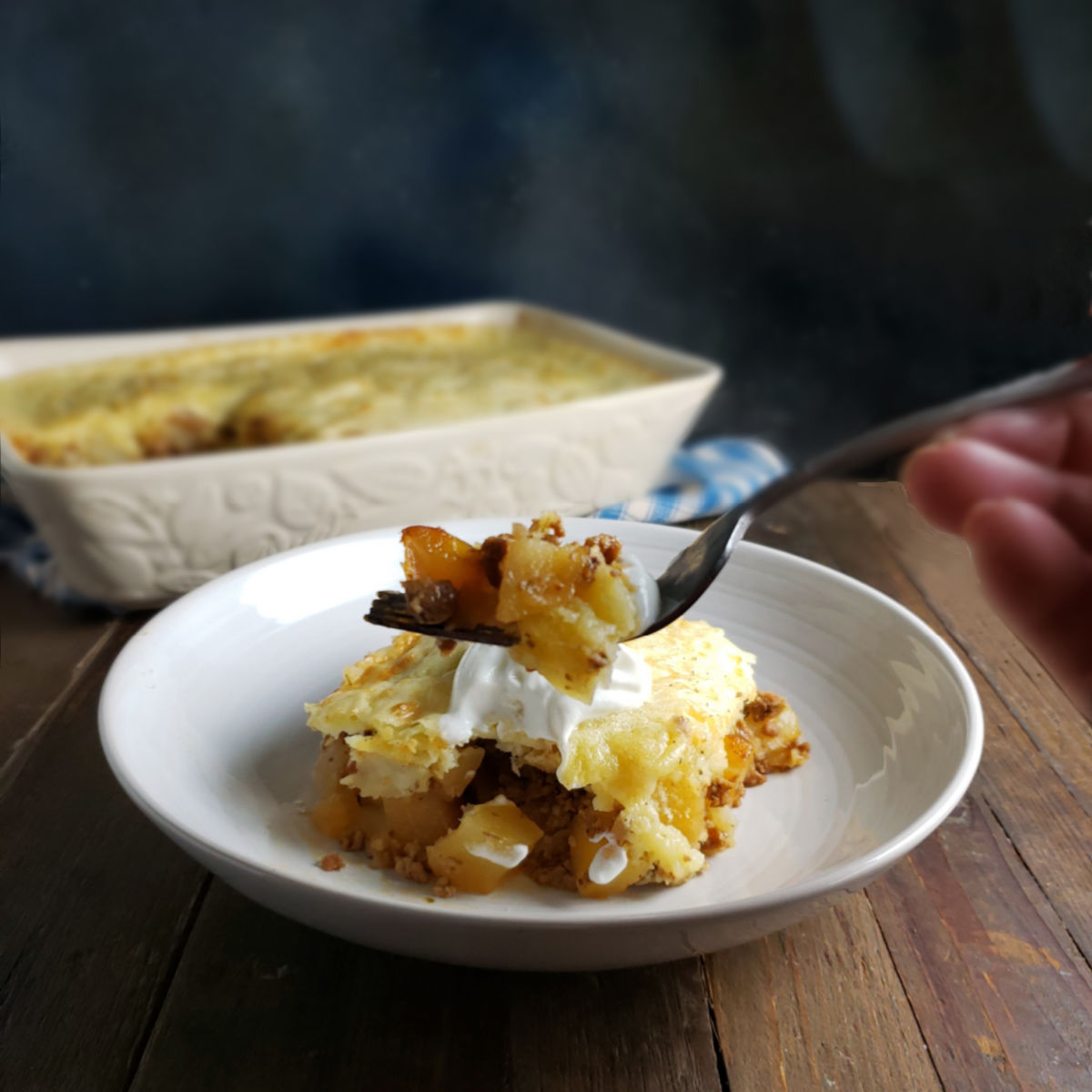

As I was thinking about this easy Traditional Bulgarian Moussaka, I realized I haven’t posted a legit casserole in ages. Since August 2023, when this easy Peppers and Chicken Bake popped out of the oven! (And into my mouth!)

Traditional Bulgarian Moussaka

I’m saying we’re overdue. Let’s talk about Traditional Bulgarian Moussaka. Unlike the Greek version, which may be familiar and often has a tomato sauce and a filling of ground beef and eggplant, Bulgarian Moussaka is based on ground beef or pork and potatoes. So meat and potatoes – how can that be wrong?
About Traditional Bulgarian Moussaka:
Bulgarian Moussaka, like the Greek version, also has a custardy topping, indisputedly the best part! (Don’t fact-check me on that; I have no stats to prove it’s the best!) I’m just sayin’. This particular version is made with yogurt, which gives it a little tang and is super easy to make.
If the topping is the best part, the potatoes come next! Their heaven. They’re a little crusty and crispy on the edges. They’re creamy inside, rich from cooking with the broth and beef or pork. I haven’t ever had a casserole where the potatoes turned out quite like this!
While Moussaka might look a little Plain Jane (there’s not even any cheese, lol!), the simple flavors shine. There’s a definite herby element to the dish; it comes from the herb, Savory, the Queen of Bulgarian spices.
Savory is described as peppery, earthy, and a little minty with notes of thyme and marjoram. I use savory in these Bulgarian Cheese Pots. I’ll give you some substitutes below if you don’t have savory.
Making Traditional Bulgarian Moussaka:
Like all casseroles, there’s some prep work, but this one is minimal (well, there are a lot of potatoes to chop). Peel them, slice off a bit so they’ll sit flat, then slice through top to bottom; stack several, then slice lengthwise, then across into cubes.
I keep wondering how cubed, frozen hash browns would work; I might try thawing them overnight, then baking them about 20 minutes to dry them before combining with the ground beef mixture.


The Flavorings:
If you don’t want to use savory, try two teaspoons of oregano and one of marjoram. If you have no marjoram, use all oregano. Other options are Italian or Greek seasoning, but then you’ve left Bulgaria!
Looking at the recipe, there’s onion, the broth, paprika, and savory. It’s fabulous in the way of old-fashioned recipes – when the flavor of food was good enough. Jazz it up if you wish, with what’s in your arsenal: onion powder, garlic powder, or maybe something spicy.
Serve With:
- Serve your Traditional Bulgarian Moussaka with a green vegetable or a mixed vegetable saute.
- You’ll need a dab of yogurt on top of each serving; it’s a necessity.
Leftover Traditional Bulgarian Moussaka:
Store in the refrigerator, tightly covered, for three to four days. This works best if cooled before covering. For best results, reheat servings, lightly covered, in the microwave.
Other Easy Beefy Casseroles You Might Like:

Classic Shepherds Pie
Saving Money on Groceries:
What you pay for groceries depends on not just WHERE you shop, but WHEN. Be strategic and stock up at rock-bottom prices.
- The best sales are before holidays; check out Win at the Grocers. Think beyond the occasion & use the opportunity to stock up at a low for the coming weeks to months.
- If available, take advantage of discount stores like Aldi or Lidl. The pricing at Buyer’s clubs is not always the lowest, but can trump in quality. Be selective when shopping there.
Ground Beef:
- Ground Beef is on sale often and freezes well – there’s no need to pay full price. Stock up at rock bottom and freeze in amounts that make sense for your family. Most recipes using ground beef call for one pound. Some can get by with a little less.
- Grocery store pricing is lowest during the summer months, and some of the lowest prices are before the Summer Holidays.
- Regardless of the time of year, each percentage of ground beef drops to a low about once a quarter; being versatile gives more options for savings. Generally, the higher the % of fat, the lower the cost, but more waste in fat.
- Ground beef is usually cheaper in larger family packs and even cheaper in the “chubs.”
- Discount stores have great sales, and your buyers’ club is worth checking.
Yogurt:
Look for the best value and purchase large cartons of decent, not top-of-the-line, plain (preferably full-fat) yogurt with live probiotics. It’s versatile and can be eaten as well as cooked or baked with in both savory & sweet dishes, and can sub in for sour cream. (Tip: add fruit, jelly, or jam to your plain yogurt to make your own flavors.)
Store opened yogurt just like cottage cheese and sour cream, upside down in the fridge. It will stay fresher longer. Make sure the lid is airtight to prevent accidents. Yogurt is good for weeks past the “Best Buy” date.
- Best pricing is usually in large cartons. Better yogurt can be found at a range of price points.
- To beat grocery store prices, shop buyers’ clubs and discount stores like Lidl and Aldi. If interested in exploring, check out ethnic markets catering to populations who rely on yogurt as a staple. For more savings, you cannot beat Making Your Own Yogurt.
Russets:
Once home, store in a dark, cool, dry area, well-ventilated, away from onions. Remove from plastic. A paper grocery bag with the top folded is ideal. It keeps them in the dark and reduces condensation.
- For best value, larger bags are cheaper per pound unless there’s a great sale on another size.
- Don’t pass on value if the potatoes look “dirty.” Those that aren’t washed absolutely clean store better.
- The largest bags might have a mix of sizes; sort and pick out larger ones for recipes needing whole potatoes; reserve others for recipes where size doesn’t matter.
- A large russet runs about 8 ounces, a medium about 5 ounces, a smaller one a few ounces less.
- Think seasonally; although never expensive, russets are in season and at their lowest from late summer through winter. Take advantage and use more often.
- Large bakers packaged and wrapped are never a good value; they’re pricy and way over normal serving sizes. Save for special occasions and pick them up at your buyers’ club.

Traditional Bulgarian Moussaka
Traditional Bulgarian Moussaka

- Prep Time: 10 minutes
- Cook Time: 1 hour
- Total Time: 1 hour 20 minutes
- Yield: 6 to 8 servings 1x
- Category: main dish
- Cuisine: Bulgarian
Ingredients
For the Casserole:
- 2 tablespoons oil
- 1 large or two smaller yellow onions, peeled and diced
- 1 1/2 teaspoons of salt
- 1 tablespoon paprika
- 1/4 teaspoon of black pepper
- 1 teaspoon beef base or a cube
- 1 pound of ground pork, ground beef, or combination
- 1 tablespoon of savory
- 2 pounds of russet potatoes, peeled and diced 1/2 to 3/4″
- 1/2 cup beef broth
- Topping, below
- Yogurt, for serving
For the Topping:
- 1 1/2 cups whole milk Greek yogurt
- 1/4 cup all-purpose flour
- 2 large eggs
- 1/2 teaspoon baking soda
- 1/4 teaspoon salt1/4 teaspoon pepper
Instructions
For the Casserole:
Grease the casserole and preheat oven to 425 degrees F.
In a large skillet or Dutch oven, add oil and heat to medium heat. Add onion, paprika, salt, and pepper. Cook, stirring often, until the onion is just a little past turning translucent and is starting to slightly pick up some caramel color on the edges, stirring often. If, towards the end, it sticks or is in danger of burning, add just a little water.
Add beef base or cube (if using) and ground pork, beef, or combination, and break up as it cooks, cooking slowly and stirring often until cooked through. This should take several minutes; no need to “brown”; the mixture should be soft. Fold in the savory and potatoes.
Move mixture to greased casserole, smooth the top, and slowly drizzle in the broth. Cover with foil and bake for 30 minutes. Uncover and bake for an additional 10 to 15 minutes, until potatoes are tender when pierced with a knife but not thoroughly soft. Remove casserole from the oven, turn oven down to 350 degrees F.
For the Topping:
In a small mixing bowl, mix the topping ingredients, the yogurt, flour, eggs, baking soda, salt, and pepper. Pour and nudge over the top of the casserole, making sure all is covered. Bake for around 15 minutes until lightly browned (may be spotty in places) and the yogurt is just set, but still soft. Do not overbake.
Allow casserole to sit for 10 minutes when finished. Serve with a dollop of yogurt.
| Nutrition Facts | |
|---|---|
| Servings 6.0 | |
| Amount Per Serving | |
| calories 398 | |
| % Daily Value * | |
| Total Fat 15 g | 24 % |
| Saturated Fat 6 g | 28 % |
| Monounsaturated Fat 2 g | |
| Polyunsaturated Fat 2 g | |
| Trans Fat 0 g | |
| Cholesterol 62 mg | 21 % |
| Sodium 798 mg | 33 % |
| Potassium 839 mg | 24 % |
| Total Carbohydrate 43 g | 14 % |
| Dietary Fiber 3 g | 13 % |
| Sugars 11 g | |
| Protein 22 g | 44 % |
| Vitamin A | 12 % |
| Vitamin C | 49 % |
| Calcium | 16 % |
| Iron | 21 % |

7 thoughts on “Traditional Bulgarian Moussaka”