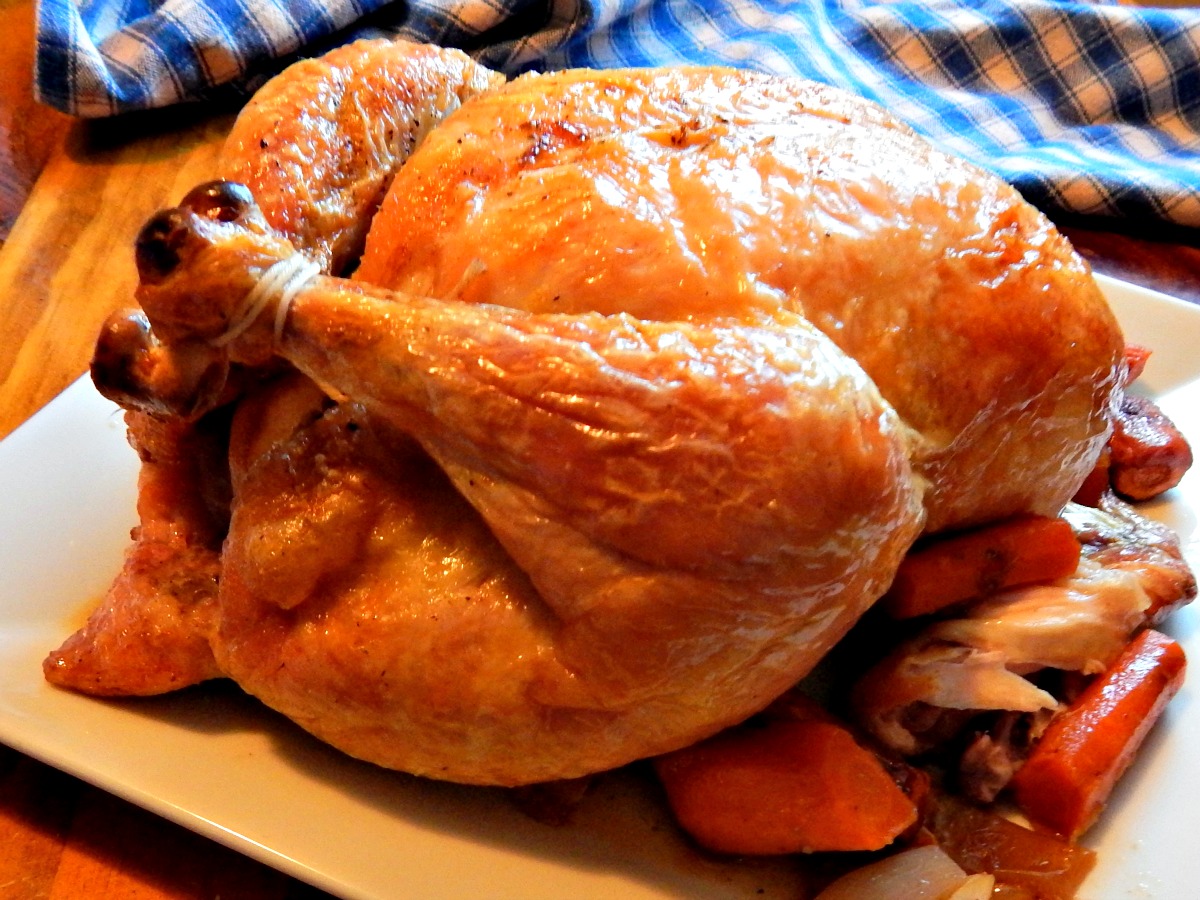

Sunday Roast Chicken is as you can get to a “set it and forget” chicken, and the method (so easy it’s hardly a method at all) is pretty much hands-off. There are none of the recent tricks seen on TV trying to get the perfect bird. There’s no fussy turning the bird upside down, adjusting temperature, etc. This is just a classic roast chicken done in the way your Grandma would recognize. Period.

Sunday Roast Chicken, Lemon Variation for Easter 2015.

Here the chicken shines, enhanced only by a bit of salt and pepper, a touch of butter, and a sprig of herb. (If you’re looking for more flavor, consider the Lemon Roasted Chicken variation in the recipe.)
About Sunday Roast Chicken:
This is truly a one-dish meal – the vegetables (of your choice, below) are roasted under the chicken basting in all that flavor. The drippings are defatted and served alongside. It couldn’t be easier; it couldn’t be better!
This is larger than your average supermarket chicken these days, six pounds, which is enough to feed a family of four, and still have a bit left for another meal or two. That of course, depends on how the family eats; I always recommend stretching the main protein with lots of vegetables. It’s healthier and usually better on the budget…depending on the veggies used!
Here you’ll have your choice of several veggies. I gotta say I’m all for potatoes and carrots, which are classic and dirt cheap, but only because I love them! Honestly, you can go with any of the veggies listed in the recipe without breaking the bank, so you do you, boo! I think you’ll find that fennel is going to be the priciest (as well as one of the veggies that don’t go as far as some of the others.

Sunday Roast Chicken – this is just so perfectly juicy. “Regular” variation.
Making Sunday Roast Chicken:
When I say this chicken is set it and forget it, I mean it! I wish I had gone for the full one-minute truss I use now, rather than just letting it be as in one pic or just tying the legs together as in the other. A truss makes a more attractive bird, helps it to cook evenly, and keeps the wing tips from burning, which helps with the stock, later.
My one-minute truss is explained in detail in my post for Rotisserie Chicken (No Rotisserie Needed.) The pictures are included, below.
The biggest thing to know about this or any chicken is to cook it until the temperature is about 160 degrees F. in the thickest part of the thigh. Remove it from the heat and tent it with foil. Let it rest and the temperature will continue to rise to a safe 165 degrees F.
The color, which can range from pink to tan is not reliable. Myself, anything pink gives me the heebies even though I know it’s safe and the color is a chemical reaction. If that’s you, too, and you’re unable to reprogram your thinking, remove the legs and the breast and put the rest back in the oven for a few more minutes.
-

- The pricing of this chicken.
-

- Wrap legs tightly with string, pull string back over wings and tie behind the neck cavity.
-

- Tuck in tail, cross string to hold it in, bring across to thighs.
-

- Tie just like a square knot with one extra loop – it holds tight so the knot can be finished
-

- Bring string along bottom of thigh & back toward wings
-

- String goes over wing & right across neck opening – over loose skin
-

- The chicken trussed!
-

- Sprinkle HEAVILY with the rub.
The Lemon Chicken Version:
As good as this chicken is simply roasted, it’s just as good with the lemon variation in the recipe. There’s not a whole lot of difference in the ingredients; two lemons are used rather than one, but those lemons are stretched to the utmost.
Lemon slices from one lemon are layered in with the veggies and the zest from the other is mixed with butter to tuck under the skin. The juice is reserved to add to the sauce. Finally, the spent halves are tossed inside the chicken where any remaining flavor leaches out into the inside of the bird.
The other change is to use a bit of white wine (optional) in the sauce. It’s transformative. I love what wine does to a dish like this.
Leftovers:
As time passes, the amount of time the FDA says it is safe to keep leftovers grows shorter! It’s now recommended to keep chicken for four days only.
Look for ways to “divide and conquer” and – use a larger protein like this as the first meal, then for a second meal later in the week. “Sunday” dinner (about $6.36 when I made mine) is a little more expensive but becomes more reasonable when a chicken casserole is served as a second meal. The cost of the two meals can be averaged. Any leftover veggies can be served for the second meal, maybe a mash or puree? or tossed in the soup…
The larger flex is making Chicken Stock or Broth (save any drippings or sauce that aren’t used for the 1st dinner to add to the stock) with the carcass. Anytime there’s a great stock, think about making SOUP. I’d recommend Chicken Noodle Soup or Pho Ga two soups on my site that depend on a great stock
The broth or stock made from the Lemony variation is perfect in Chicken & Rice Soup or this Elegant Mushroom Lemon Basil Soup.
Saving Money on Sunday Roast Chicken:
As mentioned above, your choice of veggies rule, here. Just be aware that using the least expensive ones helps keep this dinner at a low, and using every bit of the chicken helps keep a budget in line. Below are some hints on when/how to find whole chickens that won’t break the budget.
Whole Chicken:
Whole chickens, especially the larger ones, are more available in the spring (a few weeks after Easter, when the need for layers has passed.) Know the highs and lows in your area and shop around if you don’t see an advertised sale. Even if not on sale, you might find them cheaper than other alternatives for a Sunday dinner.
This dish is so cost-effective, that you might want to load it up with even more veggies; if you love having them leftover to heat up later, especially. If you buy in larger bags, make sure to keep an eye on them and use them promptly.
I hope you enjoy this Sunday dinner as much as we have!
Mollie

Sunday Roast Chicken, Lemon Variation for Easter
Sunday Roast Chicken

Ingredients
- 5 to 6-pound whole chicken
- 1 teaspoon butter, room temperature
- salt and pepper to taste
- Herb of your choice: sprig of tarragon, rosemary, thyme, marjoram, or a sprinkling (pinch or two) of dried.
- 1 lemon, halved optional
- 8 medium carrots, cut in 3″ pieces
- 2 large onions, chopped coarsely
- Vegetables of your choice according to season and availability: Potatoes, Sweet Potatoes, Rutabagas, Parsnips, Fennel, Butternut Squash, cut into 2 1/2 to 3 inch chunks. Allow an appropriate number per person.
- 1 tablespoon olive oil
- Water, for the pan
See below for additional ingredients and instructions for lemon variation.
Instructions
Preheat oven to 425 degrees, put shelf on lower middle position.
Prepare chicken: wash if necessary and remove any pin feathers, remove giblets and neck (if there.) Salt and pepper the inside of the bird. Stuff with the peelings from the onions, a lemon if desired, fennel fronds (if using fennel), and herb of your choice. Truss your chicken – see my post on How to Truss a Chicken in One Minute for slides.
Scatter vegetables in pan. Drizzle with olive oil and toss to coat. Salt & pepper, if desired. Place the chicken on top, breast side up. Bake for about 15 to 30 minutes, then rub the top with butter and sprinkle with salt and pepper. (Because this is a basic chicken with no additional rubs, herb butter, etc., the salt and pepper are important to the flavoring and the texture of the skin.)
Bake about an hour and a half until the thigh registers 165 to 170 when a thermometer is placed in the thickest part of the thigh. Be careful the thermometer is not hitting a bone.) In a smaller oven, it may be necessary to rotate the chicken halfway through the cooking process so it is cooking evenly on all sides.
Remove Chicken from the pan, place on a platter, tent lightly with foil, and rest for 20 minutes. Remove vegetables and place with chicken. Defat juices and pass with the chicken.
If desired, after defatting chicken juices, pan may be deglazed with a cup of broth, scraping up browned bits. Bring up to a boil, reduce heat slightly, and simmer for five minutes or so to concentrate flavors. Strain, pressing on any remaining solids. Taste for seasoning. Add to the juices.
Note: Check the vegetables now and then throughout the cooking process to make certain they are not getting overly dark or in danger of burning. Add a bit of water to the pan if necessary.
Lemon Variation:
The lemon flavor can very easily be brought forward in this dish. Use two lemons.
Slice one lemon and add to the vegetables on the bottom of the pan.
Zest the the other lemon, cut in half, squeeze, and reserve the juice and zest. Place the two lemon halves inside the bird. Mix lemon zest with about a tablespoon of butter, a 1/4 teaspoon salt, and a grind or two of pepper and work under the skin of the breasts, as far down into the leg as possible.
For sauce, add the reserved lemon juice to the drippings and reduce as suggested in the recipe. White wine can be substituted for the broth.

Pingback: sharktube.tv » Family Meals Matter: Celebrate food day with family meals