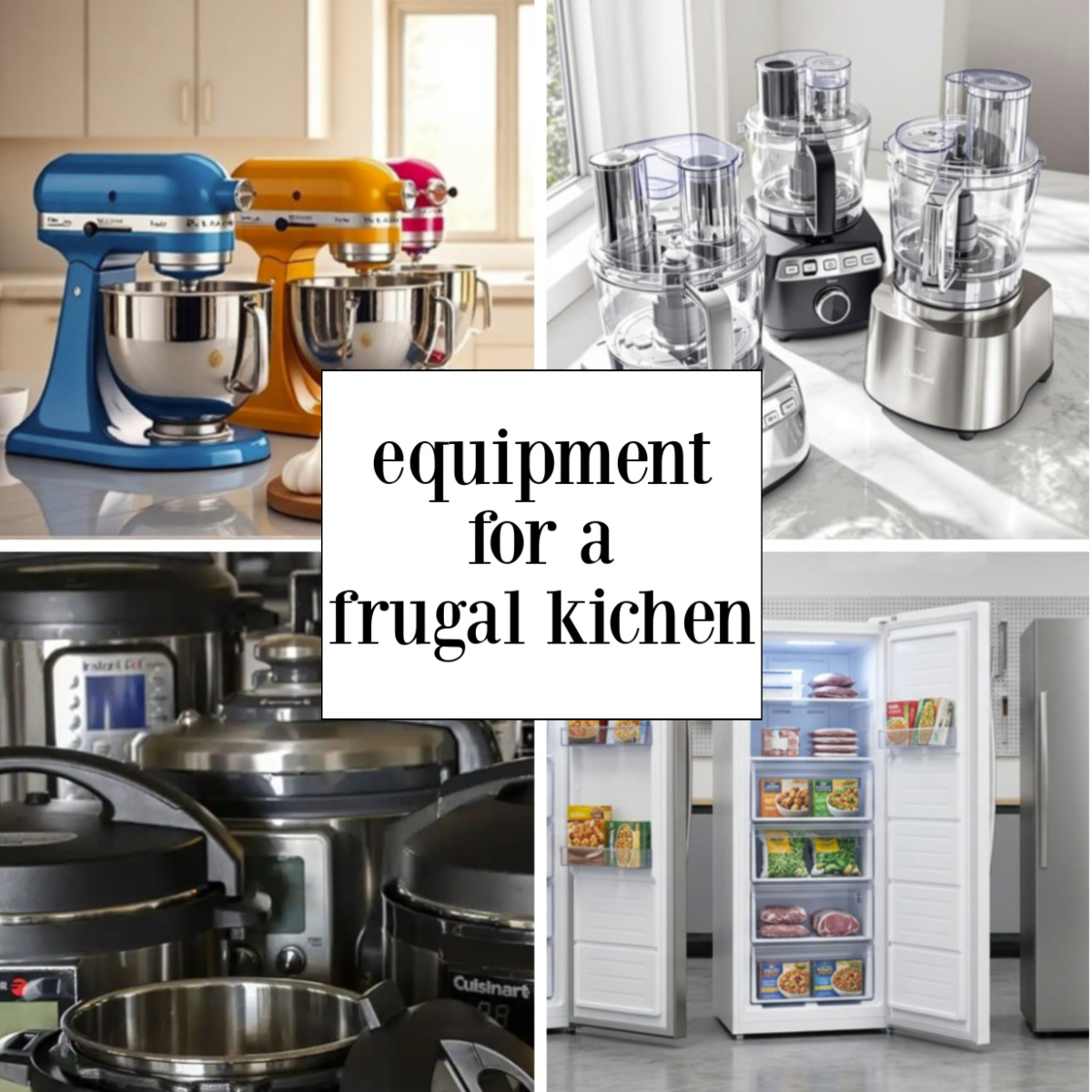

My kitchen, like many frugal kitchens, is ingredient-driven. I don’t spend money on expensive convenience foods. I save money by buying basic staples and other ingredients at the right price, then turning them into meals.

A frugal kitchen lives in the space between buying ingredients and serving dinner. That’s where the work happens: cutting, portioning, freezing, preserving, grinding, chopping, shredding, kneading, and storing. The right equipment makes that work easier, faster, and less expensive.
That often means buying larger quantities when prices are low, breaking them down, freezing portions, and doing a little prep now to make cooking easier later. It’s a system that saves money, preserves flexibility, reduces waste, and helps me avoid paying premium prices when I need something in a hurry.
I’ve never believed that cooking on a budget means settling for poor-quality equipment. We deserve good food, and we deserve tools that make cooking easier and more enjoyable. The trick isn’t buying the cheapest equipment. It’s buying the right equipment, at the right price, matching quality to your needs and the way you cook.
Over the years, I’ve found that a relatively small collection of well-chosen tools makes all the difference. Some are everyday basics, but many aren’t found in every kitchen. But every single one has earned its place by saving time, reducing waste, improving the food I cook, or helping me get more value from the groceries I buy.
Think of your kitchen equipment as an investment in your kitchen rather than a collection of gadgets. Every item on this list has paid for itself many times over by making scratch cooking easier and helping me take advantage of good grocery prices.
Before buying any new piece of equipment, ask yourself:
- Will I actually use it?
- Does it help me cook better?
- Will it save money over time?
- Is there a less expensive version that does the same job?
- Is the premium version worth the extra cost?
- Am I paying for features I’ll never use?
- Where will I store it?
Now, let’s look beyond the basics. Every kitchen needs pots, pans, and measuring cups. Below are the tools that have earned a permanent place in my frugal kitchen and why.
Equipment That Pays for Itself
These are the investments that have the biggest impact on a frugal kitchen.
- Freezer
- Food Processor
- Stand Mixer
- Pressure Cooker
- Kitchen Slicer
- Good Knives
- Extra of Basic Equipment
Freezer: If I could recommend just one investment for a budget kitchen, it would be a freezer. A freezer makes almost every money-saving strategy easier. It allows you to buy foods at their lowest prices, preserve them until you need them, and build a supply of ingredients purchased on your schedule instead of at today’s prices.
A freezer also turns extra time into future convenience. Whether you’re freezing portions of meat, vegetables, soups, casseroles, or fully prepared meals, a little work today means dinner is often just minutes away. Having meals and ingredients ready to go can be the difference between cooking at home and making an expensive last-minute trip through the drive-thru.
I talk much more about getting the most from your freezer in Bank Your Foods, and you’ll also find many recipes on this site tagged Freezes Well. A freezer is one of the few kitchen purchases that can realistically pay for itself in just a few months if you consistently buy food on sale. Considering that many modern freezers cost only a few dollars a month to run, it’s hard to think of another appliance that provides a better return on investment.
Food Processor: If there were one small appliance I’d replace immediately if mine quit tomorrow, it would be my food processor. It makes quick work of chopping, slicing, grinding, shredding, mixing, and pureeing, turning scratch cooking into something practical even on busy days.
You don’t have to buy the most expensive model to get a great machine. My first food processor cost just $39.99 and lasted nearly 20 years. My second, a mid-sized Cuisinart I found on sale for about half price, has been going strong for well over a decade. Between the two, I’ve spent surprisingly little for more than 30 years of service.
That doesn’t mean the premium models aren’t worth considering. They often have stronger motors, more capacity, and can handle tougher jobs with greater ease. If you’ll use those features, they may be worth every penny. But for many home cooks, a solid mid-range model bought on sale offers the best value.
As with any investment, do your research before you buy. Read reviews, compare features, and look for holiday sales or clearance bargains. A good food processor will pay you back every time it turns a pile of inexpensive ingredients into dinner in just a few minutes.
Stand Mixer: A stand mixer isn’t absolutely essential, and a good hand mixer will handle many everyday jobs just fine (I still use mine often.) But if you enjoy baking or regularly make bread, pizza dough, cookies, cakes, frostings, mashed potatoes, or other foods from scratch, a stand mixer is a wonderful investment.
It’s one of the hardest-working appliances in my kitchen. Besides baking, I use it to shred cooked chicken or pork in batches, whip large quantities of potatoes, mix meatloaf and meatballs, and tackle jobs that would be tiring to do by hand. There are also dozens of attachments available, from pasta rollers to meat grinders, allowing the mixer to do even more.
I didn’t buy my first stand mixer until I was in my forties. Looking back, though, it’s one purchase I wish I’d made much sooner. All the bread I hand- kneaded over the years! If you’re interested in owning one but don’t want to pay full price, see my article on How to Buy a Large Kitchen Appliance on a Budget, where I share the strategy I used to buy my KitchenAid and other appliances, for much less than retail.
Pressure Cookers: If I could add one more appliance that has earned its place in my kitchen, it would be a pressure cooker. I started with a traditional stovetop model years before electric pressure cookers became popular. In fact, when I first wrote about pressure cookers, I only knew one other person who owned one! Today, there are several excellent options, and each has its strengths.
A stovetop pressure cooker reaches higher pressure, cooks a little faster, and gives you more control, making it my favorite for many dishes.
An electric pressure cooker, such as the Instant Pot, or other multi-cookers, is wonderfully convenient. It regulates the pressure for you and often includes sauté, rice, yogurt, slow-cook, and other functions, making it a versatile all-around appliance.
It took a while for me to fully trust my Instant Pot, but when I finally embraced it, I donated my old stove-top model. I’ve written about the Pros and Cons of an Electric Pressure Cooker, including what it does well and when not to bother using one.
Finally, an electric pressure canner combines pressure cooking with approved pressure canning for low-acid foods. If you preserve your own food and want to move beyond water bath canning, invest in this.
Kitchen Slicer: Most people think of a kitchen slicer as something that’s only useful for slicing deli meat, but I use mine for much more than that. It’s wonderful for slicing roast beef, turkey, ham, or pork loin paper-thin for sandwiches, but it also makes quick work of cheese and sausages for professional-looking deli trays, onions for French onion soup, potatoes for gratins, cabbage for slaw, and other vegetables that benefit from even slices.
I even use mine to break down sale-priced roasts into steaks, cheap rump or round into slices for Swiss steak, pork loin for Pork Tenderloin sandwiches, and various cuts into slices for everything from stir-fries to stroganoff.
I don’t use mine every day, so I chose an inexpensive folding model rather than a heavy-duty commercial machine. It has served me well for years. That’s a good example of matching your purchase to your needs. If you’ll use a slicer every week, investing in a premium model may make sense. If you’ll only pull it out occasionally, an affordable model may give you all the value you need.
While I don’t bother with it for a single onion or a couple of slices of meat, it’s a tremendous time-saver when I’m preparing food in larger batches and saving money on items you might normally buy. If you’d like to see more ways I use mine, take a look at my post on Kitchen Slicers.
Slow Cooker: A slow cooker is one of those appliances that I don’t use very often, but when I need it, nothing else quite takes its place. It’s perfect for entertaining, potlucks, and recipes that benefit from hours of gentle cooking. I especially like mine for make-ahead mashed potatoes for a crowd, caramelizing onions, keeping foods warm at parties, and making seasoned nuts.
Many people absolutely love their slow cookers, but I’ve never relied on mine the way others do. During the years I worked outside the home, my commute and long workdays meant food often cooked far longer than intended. By the time I picked up the kids, fought traffic, and finally walked through the door, dinner had been cooking for eleven or twelve hours. That’s more than many recipes can tolerate.
They also aren’t my favorite appliance to clean! Still, they’re inexpensive, dependable, and when you need one, they’re hard to replace. Whether it earns a permanent spot on your counter depends entirely on how you cook and your family’s schedule.
Prep Tools That Save Time
These are the workhorses that make scratch cooking practical and will make you a better cook for very little cost:
- Mini Food Chopper
- Kitchen Scale
- Thermometers
Mini Food Chopper: If there’s one kitchen gadget I wish I’d bought sooner, it’s my mini food chopper. (I never bought one because I had a big one.) It doesn’t take up much counter space, stores away easily, and is one of the quickest, easiest appliances to use and clean.
It’s perfect for all those little jobs that don’t justify pulling out a full-sized food processor: mincing garlic, chopping an onion or pepper, making fresh breadcrumbs, mixing salad dressings, chopping herbs, grinding a handful of nuts, or making small batches of pesto, sauces, and spreads.
Because it’s so convenient, I’m much more likely to reach for it instead of doing everything by hand. For anyone who cooks from scratch, it’s a small investment that saves time, encourages you to prep fresh ingredients, and makes everyday cooking just a little easier.
Kitchen Scale: Don’t think of a kitchen scale as something only serious bakers need. Mine has saved me money countless times. I started with a simple spring scale years ago and eventually replaced it with an inexpensive digital model that reads in both ounces and grams. The metric setting has been especially helpful when converting recipes from some of my favorite international food blogs.
A kitchen scale is invaluable for portioning large packages of ground beef, chicken, pork, and other meats for the freezer, weighing ingredients for baking, and checking package weights. More than once, I’ve discovered meat packages that were several ounces under the labeled weight. While that’s not something I expect to happen often, it certainly paid for the scale that day.
An accurate digital scale costs surprisingly little and earns its keep quickly. Once you have one, you’ll probably wonder how you ever cooked without it.
Thermometers: If there is one inexpensive tool that has improved my cooking, it is a good digital thermometer. For years, I owned only a candy thermometer and a small instant-read thermometer that came out at Thanksgiving or when I made the occasional large roast – assuming I remembered to use it and could find it.
I was already considered a good cook, but once I began using a thermometer regularly, my cooking became better and far less stressful. Meat was cooked properly without guesswork, and I no longer had to nick into roasts, chops, or chicken to check the center and lose all those marvelous juices.
An instant-read thermometer is useful for quick checks, but for roasts, poultry, and other longer cooks, burgers in the oven or items on a grill, I strongly recommend a digital probe thermometer with a remote receiver. Clip it to your pocket or waistband, look marvelously geeky, and let it alert you when the food reaches the temperature you set. You are no longer tied to the kitchen, hovering over the oven and wondering whether dinner is done.
Your Most Important Kitchen Tools
These are the tools you’ll reach for almost every time you cook.
- Knives
- Knife Sharpener
Knives: Seriously, skip the giant knife block sets. They take up valuable counter space, and most home cooks simply don’t need that many knives. Instead, save that money and invest in a few quality knives you’ll actually use: a chef’s knife, a serrated bread knife, a paring knife, and a long slicing knife. If you regularly trim meat or fish, add a boning or fillet knife.
Do a little research before you buy. Even if you aren’t planning to purchase from a kitchen store, visit one anyway. Talk to the staff, handle several knives, and compare different brands, styles, and sizes. You’re looking for a chef’s knife that feels like an extension of your hand. One that’s well-balanced, comfortable, and the right size for you. You may wish to see recommendations from Cook’s Illustrated and Serioius Eats.
Many respected knife manufacturers offer both premium and economy product lines. Just because a knife carries a famous name doesn’t necessarily mean it’s built to the same standards as that company’s higher-end knives. Premium knives are often forged rather than stamped, use higher-quality steel, hold an edge longer, and simply feel better in use. A good chef’s knife is one place where spending a little more is usually money well spent.
If you have room in your budget, I’d recommend a second chef’s knife. It sounds extravagant until you’re preparing a meal and constantly moving between meats, vegetables, herbs, and fruit. It’s also invaluable if more than one person is cooking in the kitchen. If a second premium knife isn’t in the budget, even an inexpensive chef’s knife that you sharpen more often is surprisingly useful.
I store my knives on an inexpensive magnetic strip from the hardware store. It keeps them within easy reach, saves valuable counter space, and is much easier to keep clean than the inside of a traditional knife block. A sharp knife is safer, easier to use, and makes cooking much more enjoyable. I sharpen my knives regularly and use a knife sharpener, but if you’ve bought your knife at a kitchen store, they often offer free sharpening.
Knife Sharpener: If you invest in good knives, invest in a way to keep them sharp. An electric knife sharpener is one of the hardest-working tools in my kitchen. In just a few seconds, I can bring a dull knife back to life.
Knife purists may argue that sharpening by hand produces the best edge, and they’re probably right. But for everyday home cooks, an electric sharpener is fast, easy, and convenient enough that you’ll actually use it. Cook’s Illustrated put electric sharpeners through extensive testing, sharpening knives hundreds (if not thousands) of times to measure wear, edge retention, and performance. They found that while electric sharpeners do remove slightly more metal and can alter the edge over time, the amount is minimal, especially when weighed against the benefit of consistently sharp knives.
If you’ve never cooked with truly sharp knives, you may not realize what you’re missing. I once spent nearly half an hour cutting Hasselback potatoes at my daughter’s house with dull knives. The same job took about ten minutes in my own kitchen. Another time, I struggled through a head of red cabbage at a friend’s house, only to realize later that the problem wasn’t the cabbage. It was the knives. Sharp knives glide through food, make prep work faster, and are actually safer because they require less force and are less likely to slip.
For around $20, an electric knife sharpener may be one of the best investments you can make in your kitchen.
Multiples of the Basics:
These inexpensive workhorses remove frustration and make cooking much more efficient.
Buy Multiples of the Basics: If there’s one place I encourage you to have duplicates, and sometimes triples, it’s the everyday tools you reach for constantly. Over the years, I’ve accumulated multiple serving spoons and ladles, rubber and metal spatulas, three sets each of measuring spoons and sturdy metal measuring cups, Pyrex measuring cups in several sizes, plenty of good sheet pans, a few heavy-duty baking sheets, and a couple of old, battered ones reserved for catching drips in the oven.
The same goes for basic baking dishes. Having two (or four) loaf pans and multiples of casserole dishes means you can prepare more than one recipe at a time without stopping to wash dishes in the middle of cooking, and if you’re freezing, you can freeze several casseroles at once.
These aren’t glamorous purchases, but they’re some of the most useful. Nothing is more frustrating than having to stop in the middle of a cooking session because your measuring spoons or cup is wet, your rubber spatula is sitting in another bowl, or your one good sheet pan is already in the oven. Duplicates make cooking and baking smoother, faster, and a lot more enjoyable. (And I have multiple beaters for my stand mixer, too.)
Nice to Have
Not essential for everyone, but wonderful if they fit the way you cook.
- Grill Pan, Contact Grill, or Panini Press
- Waffle Maker
- Ice Cream Maker
- Air Fryer
Grill Pan, Contact Grill, or Panini Press: Some type of indoor grill can be handy, whether it’s a cast-iron grill pan, a George Foreman-style grill, or a combination grill and panini press. Over the years, I’ve owned several. Looking back, I probably should have skipped the expensive electric grill and bought a good cast-iron grill pan instead. The electric grill took up a lot of storage space, was difficult to regulate, and never seemed to get quite hot enough or stay hot enough for the results I wanted. A simple cast-iron grill pan would have given me better control, taken up less room, and lasted forever.
If sandwiches are your thing, though, a panini press can be a lot of fun, or you can do what I do. Just use a grill pan and add a weight on top of your sandwich. Just think about how often you’ll use it before spending a lot of money. As with most kitchen equipment, buy the appliance that fits the way you cook.
Belgian Waffle Maker: Absolutely not essential. Absolutely wonderful. Mine is one of the big flip models, and it makes restaurant-quality Belgian waffles. Since waffles freeze beautifully, I can make double or triple batches and have homemade breakfasts ready to go for weeks. For me, worth every penny and the storage space.
Ice Cream Maker: An ice cream maker certainly isn’t essential, but for me, it’s been worth every penny. I love being able to make flavors that aren’t available in the grocery store, control the quality of the ingredients, and turn seasonal fruit or leftovers into something special.
Homemade ice cream, sorbet, frozen yogurt, sherbet, and granita are all easy to make, and the results are often better than store-bought. If frozen desserts are something your family enjoys, an ice cream maker can quickly earn its place in the kitchen. I have a few recipes for no-churn ice cream if an ice cream maker isn’t in your kitchen or future.
Air Fryer: Most Air Fryers have six functions, allowing you to air fry, bake, broil, roast, reheat, and dehydrate foods. For those who love them, they’re invaluable. They use little to no oil, they’re fast, easy to clean, and can save energy over turning on the oven. The downside is that most hold smaller amounts, it’s easy to overcook delicate food, and they are heavy and bulky. They aren’t for everything: they will not work for wet batters and larger items.
Didn’t Earn Their Keep (For Me)
This is controversial, I know.
Vacuum Sealer: I owned three. I wanted to love them, which is why I tried different ones over 40 years. In the end, I found the bags too expensive for the value I was getting. I didn’t enjoy the time and process involved, and resented the storage space they took up. I do just fine with freezer bags, good wrapping techniques, and freezer containers. If you hunt, fish, buy meat by the case, or sous vide frequently, your experience may be different.
Bread Machine: I’ve actually owned two bread machines. My first was back in the 1980s, and years later, I bought another, thinking they had probably improved enough to change my mind. While they certainly had, I still preferred the flavor, texture, and crust of bread baked in the oven. For me, even though I was kneading by hand, they just weren’t the right fit and didn’t earn their storage space. If you bake several loaves a week or love the convenience of waking up to fresh bread, your experience may be very different.
When thinking about kitchen equipment, whether you’re running a frugal kitchen or a high-end one, an everyday kitchen or one where you spend hours prepping and cooking, the right equipment depends on how you cook.
Good knives don’t make someone a better cook.
Knowing how to choose and use one makes cooking easier.
A stand mixer doesn’t automatically save money.
Knowing when it’s worth buying one does.
A freezer doesn’t always pay for itself.
Knowing how to buy for it and use it well does.
The same is true of almost every tool in the kitchen. The greatest investment isn’t always the equipment itself. It’s learning how and when to use it.
Here’s the bottom line. We all cook differently, so my well-equipped kitchen probably won’t look exactly like yours. It shouldn’t. Build the kitchen that works for the way you cook, one good tool at a time.
As you do, remember:
- Buy quality where it matters.
- Match quality to your needs.
- Buy at the right price.
- Consider used or refurbished equipment.
- Don’t buy something just because everyone else has one.
- Don’t be afraid to admit an appliance wasn’t worth the money.
- Value tools that earn their place – and their space.
- Think in systems that save time and money, not gadgets.
And always remember: the best-equipped kitchen isn’t the one with the most gadgets. It’s the one where every tool has earned its place.
Continue Learning
Choosing the right equipment is just one part of building a kitchen that works for you. Read Invest in Training, one of my 12 Strategies to Win at the Grocery, to learn why developing your skills is one of the best investments you can make.

2 thoughts on “Building a Frugal Kitchen: Which Kitchen Equipment Is Actually Worth Buying?”